
Phelimuncasi
"We are here to irritate. We are here to bring gqom to the world"

In the early 2010s, in the city of Durban, South Africa, a new sound was born. Derived from kwaito, the previous popular iteration of South African house music, gqom distinguished itself through its powerful rhythm: heavy bass, and a primal drum beat. The word “gqom” literally means “bang,” an onomatopoeia meant to mimic the sound of a kick drum. With no drop in sight, gqom is practically all groove, although the music isn’t particularly groovy because the drum beat was often broken and irregular. Aggressive and menacing though, sometimes relying on darker textures and a foreboding atmosphere built from its relentless repetition.
Gqom spread rapidly. Bedroom producers played around with these new drum rhythms on FruitLoops, which quickly disseminated throughout Durban’s nightlife with special thanks to the taxicabs that played gqom beats outside clubs, and then packaged up as low-quality—which only added to the primitive charm—mp3 files that were shared on WhatsApp groups and African filesharing websites. Its appeal was summed up aptly, “In so many ways, it’s one of the truest and purest youth music movements to come from the country as it does not take influence from anything outside SA. It takes the existing vibes of kwaito and house in all its forms in SA (Durban, Bacardi etc.) and moves it forward. And yet, it exist in a bit of a vacuum even within SA. It’s not very well known and that’s a shame because Gqom is the real fucking deal.”
Jumping Back Slash, a DJ based in Cape Town, wrote that on the Stamp the Wax blog in 2014. Just one year later, I had come across gqom when UK label Goon Club Allstars packaged up Rudeboyz and DJ Lag for international consumption. Around the same time, Rome resident Francesco “Nan Kolè” Cucchi and Lerato Phiri birthed the Gqom Oh! label to enable a wider audience access to the sound. Three years later, in 2018, it was clear that the sound was not isolated to South Africa when Babes Wodumo, self-proclaimed Gqom Queen, was among a handful of African artists featured on Kendrick Lamar’s Black Panther soundtrack. Hyperdub label-head Kode9 described gqom as “like being suspended over the gravitational field of a black hole, and lovin’ it” and championed the genre in his Fabriclive 100 mix with Burial that same year.
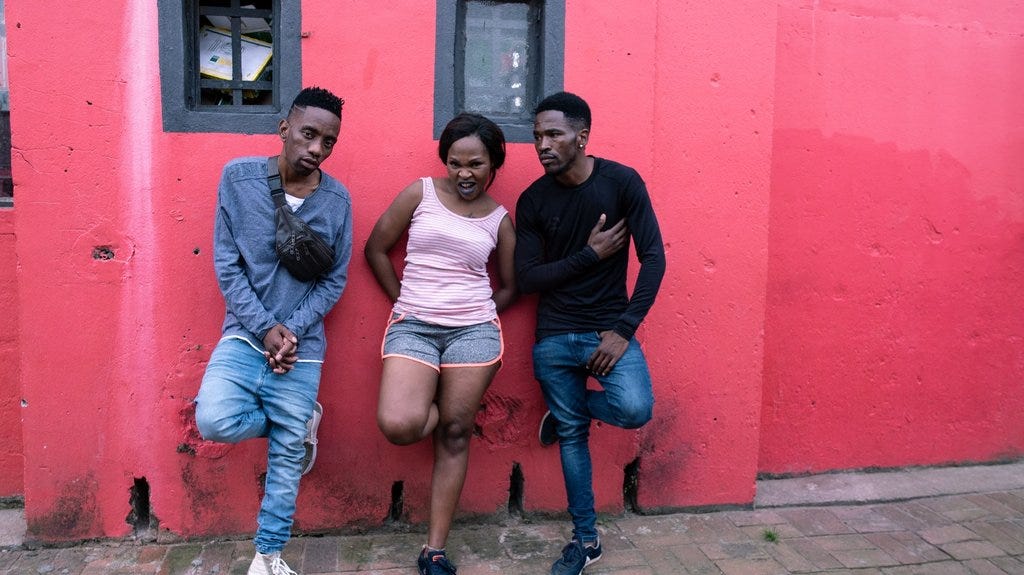
Formed in 2012 in the Mlaszi township of Durban, the trio Phelimuncasi didn’t begin with gqom in mind. Instead, vocalist twins Makan Nana and Khera were into hip-hop, but when they were joined by their cousin Malathon in 2014, gqom was already becoming inescapable. With two vocalists in tow, they lace their version of gqom with hooks, chants, and storytelling lyrics, distinguishing them early on from a sound that was largely instrumental. In addition, Malathon also pointed out in an interview with DJ Mag that just by picking an actual name like Phelimuncasi, which translates roughly to finishing a drink with a straw, that they had already set themselves apart: “Here in South Africa, most people call themselves ‘Makumolo Boyz’ or ‘Umeke Boyz.’ When you call yourselves ‘boys’, it is similar to other people. We wanted to come with something different. We are different from the rest.”
Debut album Phelimuncasi: 2013 - 2019 was released by the venerable Nyege Nyege Tapes, frankly the best label for both electronic and African music in the last few years of the 2010s. As the title suggests, the album collects songs ranging close to a decade which demonstrates gqom’s growth: songs made in 2013, produced by DJ Scoturn, are simpler in nature and shall-we-say “drier” in sound, while songs made in the last half of the decade are produced by Menzi, half of the pioneering duo Infamous-Boiz, and are darker, grittier, and stranger. The DJ Scoturn tracks can be unleashed at any house party for social lubricant, whereas Menzi opens “Private Party” with a threatening bass drone, and the beat constantly threatens to open up or drop but never does. If it weren’t for the pull of the vocalists, you wouldn’t be sure if you wanted an invite. Elsewhere, Menzi laces “GQOM Venus Cemetrary”—the shortest song on the album, but a highlight nonetheless—with an eerie high-pitched sustain, turning the earthy gqom into a sci-fi dystopia. I almost wish the album was compiled chronologically so we could more easily hear gqom’s evolution.
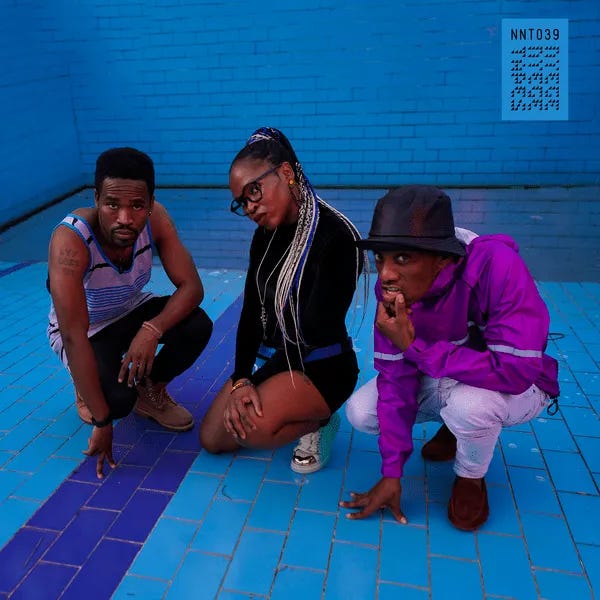
Second album Ama Gogela is their masterpiece; it might be the best gqom album that I can think of. Named after a large, South African bee, the message is clear: their music intends to possess you as if you were just stung. It’s where they capitalize on the merry-go-round of voices enabled by having boy-girl vocalists, compounded by a few extra collaborators. Opener “I don’t feel my legs” is the trio’s best song, whose hook—“I don’t feel my legs / I don’t feel my hands”—isn’t just their most direct (helps that it’s in English, of course), but it feels like a genuine release against DJ Nhlekzin’s monolithic bass programming, as well as a riposte. Don’t think you can dance to this? Just lose all feeling in your feet and hands and let go. “Inja Enamarabi Wemame Weh” is really interesting in that regard thanks to Bhejane’s lower, practically disembodied vocal that feels as integral to the beat’s fabric as DJ Scoturn’s drums. Elsewhere, they tap South Korean producer NET GALA who was in South Africa at the time to produce two tracks. Both “Ngiphupha Izinto” and “Dlala Ngesinqa” are unlike anything else on the album, both bouncing balls of energy, and the former’s use of dated electronics as an additional spring makes it feel rattling around inside a pinball machine and is reminiscent to me of early bubblegum bass where the best producers often loaded their beats with left-field sonics.
Their enthusiasm with working with someone from outside gqom or South Africa at all suggested that their follow-up might lean harder in that direction, but I still find it hard to believe that third album Izigqinamba is basically not a gqom album at all. Working with Metal Preyers in full, an industrial group made up of UK artists Lord Tusk and Jesse Hackett, rather than their usual collaborators, the trademark kick drum is almost altogether absent. “Ngicela siqoze” and “Coffin Roller,” which function as a two-part centerpiece, feature no drums at all, just pointillist synths. The latter and “Last Flutter” contain none of the vocals that made Phelimuncasi distinct from gqom in the first place. The genre is evoked in the title of “Gqom slowgen Chant,” but the rhythm is downplayed to the point of ambient; the beat of “Mgiligi wabaleka” feels softened by its fuzzed out texture. Closer “Last Flutter” has a really interesting drum beat, like an extremely large insect-robot hybrid fluttering its wings that generates a faint light that elicits a “cool” from me but not much more.
By Iziqginamba’s release in 2024, gqom’s heyday had already passed, usurped by amapiano that came to prominence in South Africa shortly after that seems easier to crossover internationally, as proven out by Tyla just a few years ago. So I don’t begrudge these three for trying to broaden their reach, and I’m still curious to hear where they’ll go next time.
Phelimuncasi: 2013 - 2019 - B
Ama Gogela - A-
Izigqinamba - C+