
Hüsker Dü
Was this your celebrated summer?

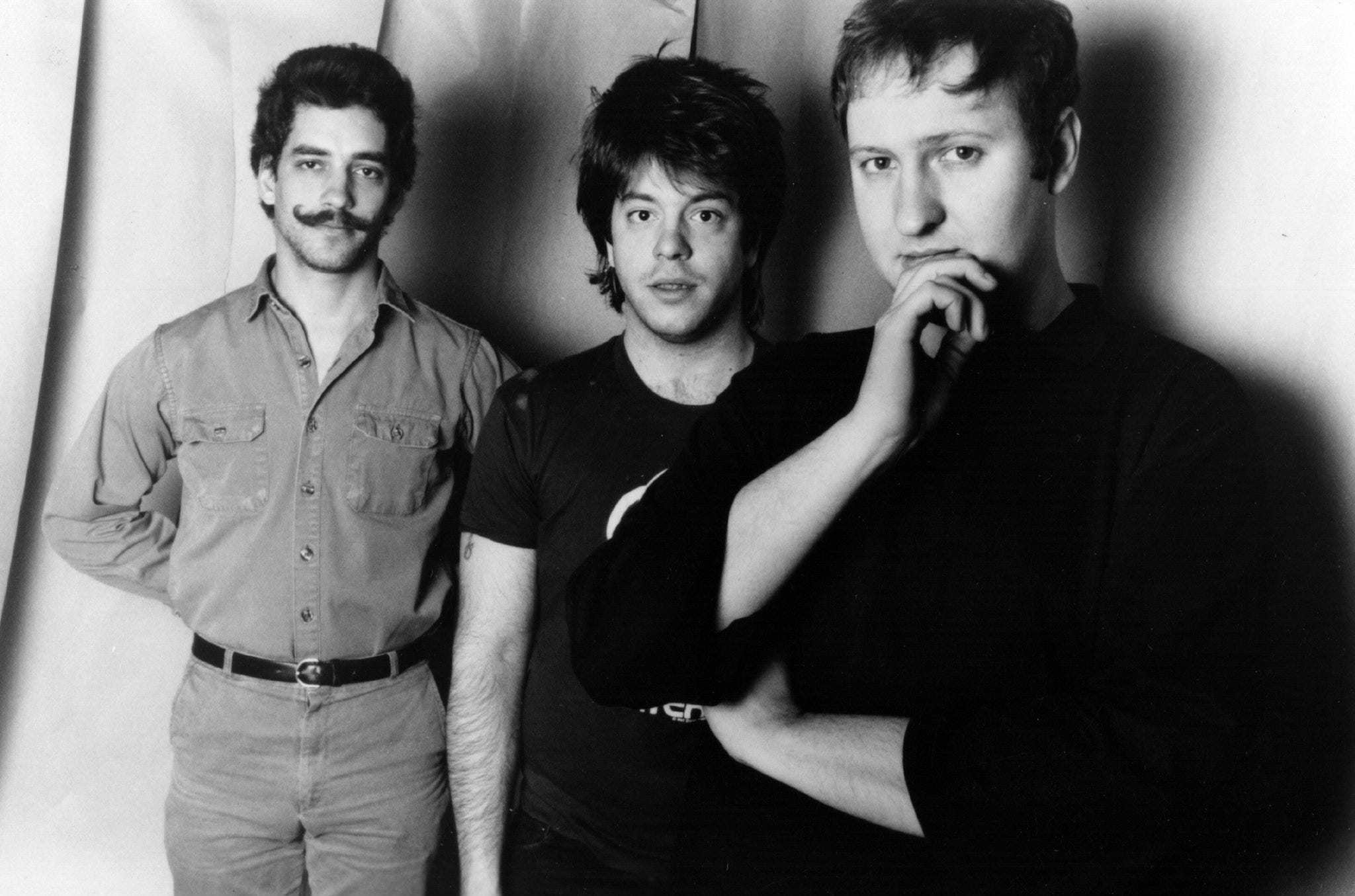
Earlier this month, people were sharing their best power pop songs on X, which prompted me to tweet this:
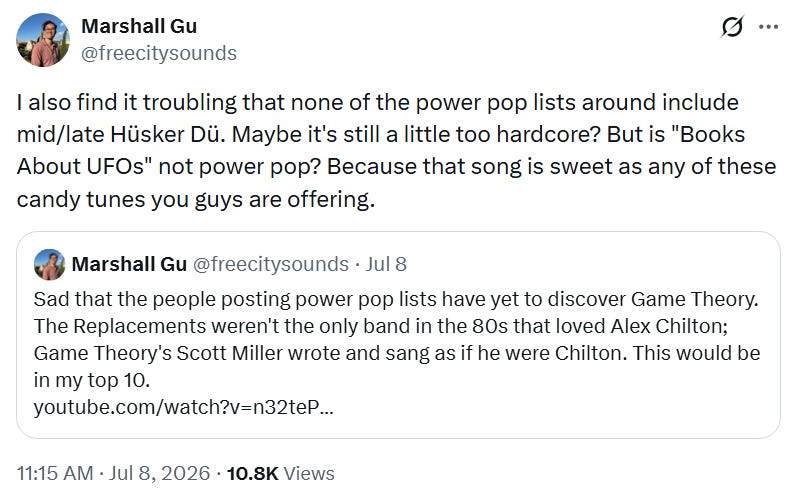
I received some pushback for it from people who refused to believe that Hüsker Dü could be filed under power pop despite the fact that this was a band that defied easy genre categorization. Even though their early records were firmly hardcore punk, they didn’t fit in with their contemporaries. They covered 60s’ Scottish folk musician Donovan on their first studio album that must have felt like a piss-take to hardcore heads at the time but quickly revealed itself to be sincere. As punk bands supposedly rejected what rock music was becoming, hardcore was rejecting what punk was becoming, but Dü didn’t reject any of it. “You know the whole deal with tearing down the old to make room for the new? Well, music isn’t city planning,” Grant Hart said. And just one year after covering Donovan, Dü did the unthinkable for a hardcore band: they made a fantastical concept double album in the spirit of the Who.
After the release of their debut (live) album in 1982, in the five years that followed that yielded six studio records—an impressive clip when you realize that two of these are double albums, and two of them were released in the same year—Hüsker Dü changed more than most any rock band that I can think of. They went from hardcore to defining what post-hardcore meant, and then signed onto a major record label and began making, yes, power pop. Is it that much of a stretch to consider Dü’s later albums power pop when you consider that (1) fellow Minnesotan indie rockers the Replacements—who also started as a punk band—did the exact same transition after signing onto the majors; (2) Bob Mould’s band after Dü, Sugar, was a power pop band through and through? What I love about Dü, besides making some of the greatest music of all time, was that you could hear them transition from record to record—is it ridiculous to compare them to John Coltrane in that regard?—even if I don’t like what they became in the end, I love witnessing how they got there. Hüsker Dü’s discography reminds me a lot of the Police’s in that you could watch the evolution of popular music styles from album to album.
Dü also deserves mention on two fronts. One, they were one of the most prominent LGBTQ+ bands of the 1980s. Guitarist-vocalist Bob Mould had left his small town in rural New York and ventured to Saint Paul where the band was formed, “I knew I was a homosexual at that point, and there was no future for me there,” while drummer-vocalist Grant Hart was bisexual. Two, they were important in the development of underground rock music in the 1980s becoming mainstream alternative rock one decade later. It’s true that Sonic Youth brought Nirvana to DGC. But before Sonic Youth themselves made the leap, the band sought advice from Hüsker Dü because Dü—with the Replacements—were among the first underground bands to move to the majors, and because when Dü signed onto Warner Bros with the promise that the band would retain artistic control. So much has been made on the Pixies’ influence on Nirvana, and yet, no one seems to bring up Hüsker Dü’s influence despite Dave Grohl being one of Dü’s most vocal champions, or that Bob Mould was considered to produce Nevermind. Would Nirvana have written “Polly” if Hüsker Dü hadn’t written “Diane” first? And famously, the Pixies only found bassist Kim Deal because they advertised for a bassist who was into “Hüsker Dü and Peter, Paul & Mary.” To say nothing of the influence on Bob Mould’s guitar style—a roar full of treble—that was an early form of noise pop and frankly even shoegaze years before Jesus and the Mary Chain released their debut album Psychocandy.
I originally wasn’t going to write an article on the Dü partly because I had already covered their two masterpieces on my the 1980s list ranking Zen Arcade at #41 and New Day Rising at #35, but also because I feel like better writers had already covered them so succinctly that it felt foolish to even try:
(1) “The Hüskers had gotten cast as a hardcore band when what they were really doing was playing folk rock played at light speed, encased in an almost palpable cloak of swarming electronic distortion, car accident drumming, and extreme volume.”
—Michael Azerrad’s immortal description of the band in the book Our Band Could Be Your Life: Scenes from the American Indie Underground;
(2) “Let me try to succinctly explain my personal attraction to Hüsker Dü, aside from physically, what with the mustache and the dumpiness. Hüsker Dü — and Bob Mould in particular — create EXTREMELY emotional music. And I don’t mean music that uses generically "sad" or "angry" notes and chord sequences to evoke an easily-predictable listener response (like a movie soundtrack[…]). I mean that (a) he sounds like he's LIVING the songs he sings, and is willing to shred his throat to pieces to make sure you understand that his feelings are not just for your entertainment, and (b) both he and Grant possess the creative intelligence to put together guitar notes and chords in new ways that STILL evoke in the listener those same old feelings of dread, butterflies in the stomach, hopelessness, manic glee and all points in between. And this is the reason generic happy pop songs that would sound perfectly good coming from lesser bands end up disappointing me to such a degree when coming out of Hüsker Dü. Both Warehouse: Songs And Stories and New Day Rising contain too many songs that are just that — SONGS. Hüsker Dü were better than that.”
—Mark Prindle
But prompted by seemingly unrelated trending tweets about power pop, I revisited their discography in reverse chronology and realized that I was wrong, dead wrong, about the placement of Zen Arcade on my 80s list. It should have been much, much higher.
Grant Hart had been drumming since he was a kid, spurned by the death of his brother eleven years older than him. “I started learning how to drum from him. He was killed in a road accident while working, so I inherited all his drum equipment when I was 10. I had this determination to pursue it, because it was this arcane stage of grief,” he told Pitchfork. In Saint Paul, Minnesota, he was working at a record store blasting Pere Ubu that prompted Bob Mould to walk in. When Mould learned that Hart was a drummer, Mould invited him back to his flat to prove he could guitar, declaring that they should form a band. Luckily, Hart knew a bassist that worked at another record store, Greg Norton.
Their debut Land Speed Record was recorded live, and released through New Alliance, the label founded by Minutemen’s Mike Watt. At the time, the band were being billed as the Fastest Band Alive, and the document is proof as its 17 songs whizz by in less than half an hour. Take it as one big, black mass of hardcore punk energy; reports that the sound quality is awful are overstated, but it is not good. “Guns Don’t Kill”—where they decried gun violence and school shootings—showed a band that was smarter than most other hardcore bands around that time, and “All Tensed Up” showed clues of the emotional intensity that also separated them, “Baby, I love you / But I’m too loaded to love you properly.” Everything Falls Apart arrived the following year as their first studio album, recorded for Greg Ginn’s SST records, and the sound quality is still questionable, but they start a pop influence break through: finger-snaps and snippets of melody on a hardcore album? Well, why not?
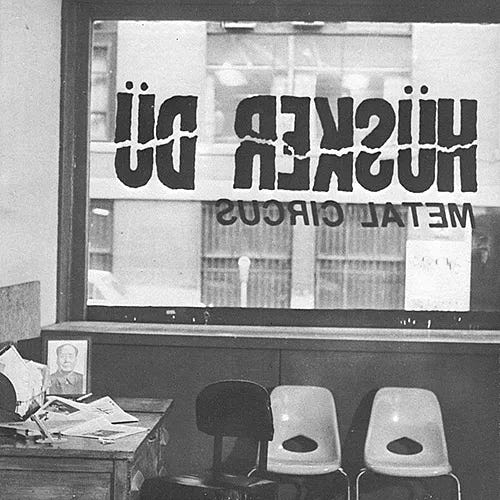
Recorded in a single day, Metal Circus is a 7-song EP that was intended to be a full album. It would have been, but unfortunately, the power cut out in the studio because they didn’t pay their electricity bills. So instead of potentially being their third-best album, it’ll have to settle for being one of the greatest EPs ever recorded. Five of the EP’s seven songs were written by Bob Mould, starting with the eviscerating “Real World” calling out fangless self-proclaimed anarchists (“You want to change the world / By breaking rules and laws / People don’t do things like that in the real world at all”) while “Deadly Skies” is a 105-second blur thanks to the high-octane guitar. But the EP’s best songs both belong to Grant Hart. First up is “It’s Not Funny Anymore,” sporting a guitar line from Bob Mould that’s strangely uplifting and even perky. But Hart writes the band’s first masterpiece in “Diane,” a murder ballad that only a hardcore band could have written, that proves Michael Azerrad’s description earlier that this was a folk rock band masquerading as a hardcore one.
In an interview in 1983 published in Conflict, Bob Mould clarified the song’s subject matter: “It’s based on a true story. There was this girl Diane Edwards who Grant knew sort of vaguely. She was working at the Perkins Restaurant, which is like Country Kitchen, one of those chains, and she was picked up hitchhiking. The guy who picked her up drove her down to Elk River, down by the Girl Scout camp there, and raped her and stabbed her over and over…it got a lot of publicity. It was in all of the newspapers, a real local thing.” “Diane” is powerful not just because of the horrifying realism of the lyrics (“But I think I’ll just rape you and kill you instead”), but also the horrifying realism of the sonics: the razor-sharp guitar blasts—pure treble—makes me imagine a sociopath driving down the road, all blue skies and lousy cheap-looking buildings. That the lyrics actually take that image all the way is the horror. The ‘life-knife’ rhyme—down there with ‘girl-world’ and ‘mystery-history’ in terms of overplayed rhymes in music—would have been clumsy in anyone else’s hands, as would be the linking of “Diane” and ‘dying’ (Vampire Weekend tried with “Diane Young” and “dying young”) but with this band, arrive with profundity.
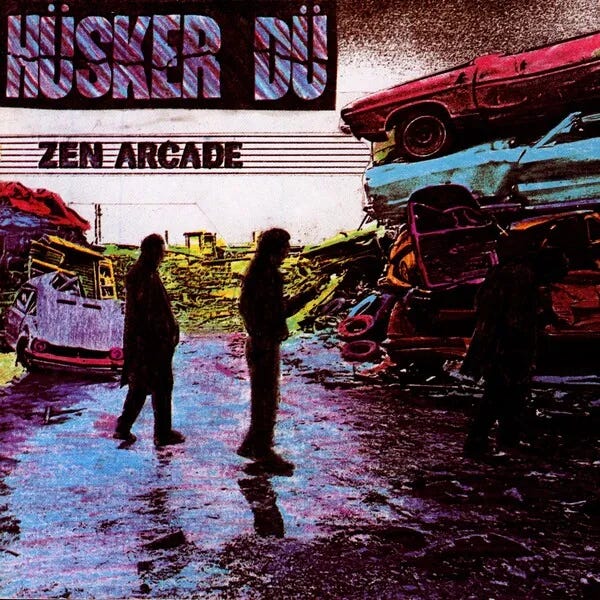
Since forming in 1979, Hüsker Dü were in a constant state of transition towards songwriting which eventually led to albumwriting, and naturally, the highest form of an album they could think of was the fantastical concept double albums by the Who. Zen Arcade is a bildungsroman of sorts, following a young man’s escape away from his broken home and his later return home after his new girlfriend overdoses. Importantly, I don’t think the concept matters, mostly because Grant Hart and Bob Mould’s vocals—and Greg Norton’s too, on “What’s Going On”—are shouted and over the din, only certain phrases stick out that’s barely enough to figure out the overarching story: “Something I learned today”; “But I’m never talking to you again”; “The sky’s the limit on this chartered trip away.”
Famously, Zen Arcade contains a lot of sounds that you wouldn’t expect from a hardcore band from piano ballads to psychedelic loops. These songs are often mentioned in reviews because it shows the band’s ambition, but they also don’t hold a torch to the main reason why we’re all here, which is to hear these three make the—let’s not overstate things here—some of the greatest rock music produced in the 80s. It’s the great Zen Arcade paradox: some of these are clear cases of filler, but they’re also part of the charm. The piano ballads have a very cheap tone where the notes are crystal clear yet have an underwater psychedelia to them. That said, don’t listen to anyone who tries to write off “Reoccurring Dreams,” the 14-minute epic instrumental that takes up most of the fourth side as there’s some truly bad-ass stuff going on here: it’s the closest hardcore has ever come to jazz fusion and vice versa. Maybe even spiritual jazz: Mould’s guitar tone during the peaks hits a psychedelic drone that I associate very strongly with Indian music.
Recorded mostly in just one take—the Dü often did this and recorded albums in proper sequence to avoid any additional costs—Zen Arcade proves just how tight they were, with Bob Mould’s guitar searing over Grant Hart’s drums hitting like mortar shells and the dirty and heavy thud of Greg Norton’s bass. “Beyond the Threshold” covers an insane amount of ground in less than 100 seconds, which is when the protagonist reaches the big city described as an “A big desert / Asphalt desert” and a screamed hook that repeats the title that makes it genuinely feel like the protagonist—or you, the listener—is lost in the city and losing their grip on reality as they look for a place to sleep. Norton’s bass on “What’s Going On”—not a Marvin Gaye cover—is filthy, flinging itself against against the no wave noise electric guitar with its entire body like an elastic. “Pink Turns To Blue”—whose title would be adopted by a German wannabe Chameleons band—is about the protagonist’s girlfriend’s skin colour changing after an overdose, has a chorus that’s sung rather sweetly in a higher pitch than on the rest of the album, their second-most horrifying song after “Diane.” “Turn On the News”—with the back-and-forth roar of vocals, “TURN ON / TURN ON / TURN ON THE NEWS!”—feels like hardcore punk’s most punk rock song.
That’s a speed-run through some of my favourite tracks strewn across all of Zen Arcade, whereas Minutemen’s Double Nickels on the Dime by comparison lost steam on its fourth side, the Dü keep it going all the way through. And yet, my favourite side will always be the first one. Norton’s bass is by turns, disgusting in its churn (“Something I Learned Today”) or delightfully hooky (“Broken Home, Broken Heart”). And then, after four minutes, the band lets you know that this ain’t your typical hardcore album by bringing in an acoustic guitar to lead “Never Talking to You Again” that might be acoustic punk’s greatest fuck you, and the furiously strummed acoustic feels just as powerful in Mould’s hands as does the buzzsaw of his electric: it’s rare to see someone with such a unique way of playing electric guitar be able to translate that into acoustic. And then, we get the album’s best song in “Chartered Trips,” where Mould starts learning to shape his voice into a melody, and what a melody! I often don’t let the song get past its 20 seconds before hitting replay to hear the addicting roar of Mould’s axe, to relish in that melody, and to marvel at the lyrical detail of “I picked up my belongings in a nylon carry-all.” It’s not enough that the protagonist through everything in a bag. It’s that it’s a nylon carry-all that makes it seem like they don’t have much belongings to save in the first place.
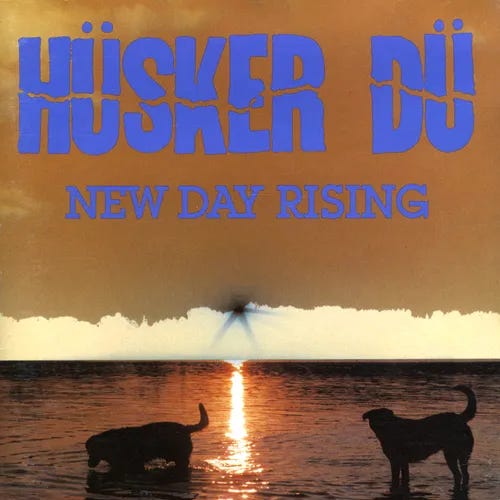
After demonstrating that hardcore music should be taken as seriously as prog on Zen Arcade, Hüsker Dü prove something else on follow-up New Day Rising: that hardcore could be sweet, replete with bubblegum melodies and vocal harmonies. This is everything I wanted Jesus and the Mary Chain’s Psychocandy: a marriage of pop and noise, and I find the feedback from Hüsker Dü to be that far more bracing and unique, generated from the treble of guitar turned all the way up. Some of the best-ever Dü songs are found here, including “Girl Who Lives on Heaven Hill” where Greg Norton’s bass-line functions as a hook in itself; “Celebrated Summer,” with its breathing room section that feels like it wandered in from a bucolic prog album and not a hardcore band; “Books About UFOs,” with its absurdly catchy piano jingle.
It’s true that the album patters out near the end—the nadir is “How To Skin A Cat” where they read out words from a 1875 advertisement—but the first ten songs would have been more than enough, just hit after hit in the vein of the 60s’ rock albums that Dü were a huge fan of. Being a hardcore band, their interests in sound trump all else, including language, hence the opener which just repeats “New day rising” over and over: it takes musicianship on an extreme level to be able to make a song out of a 3-word hook, and the results of the opening volley from Grant Hart and the swelling vocals make me think of the cover, like a celebrated summer’s just on the horizon. As a result, when the hooks aren’t big and obvious, you gotta really search for the words buried underneath the alternating sear and crunch of the guitar. But some of them turn out to be worth the trouble: “Worn out shoes and a worn out dress / A worn out smile that she’ll wear some more”; “I’m going to turn into a lens and focus all my attention / On finding a new planet and naming it after her.” That last one! Golly, Grant Hart, you’re so sweet!
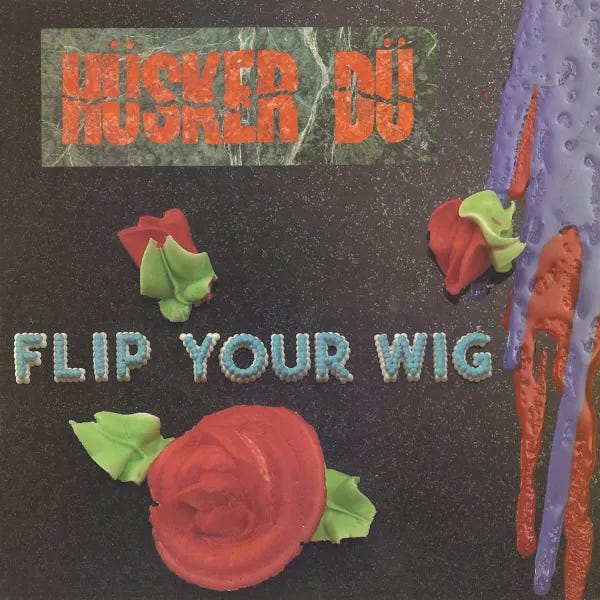
Flip Your Wig was released the same year as New Day Rising prompting the band to remark that 1985 was their “miracle year.” That they also began recording their major label debut that same year means that they struck a quality of work and work ethic that has frankly not yet been surpassed by anyone ever; yes I know that Future dropped four projects in 2015 or that Drake dropped three this year. I used to think that this was their transition album as it was their last for SST before moving to Warner Bros., but now I have realized they were always in transition, and proof is that the band only put it out on SST only because they felt they owed the label one more. (It’s fascinating to wonder how the sound would have been different had this been their major record debut.) Azerrad asserts that it’s their “best, most consistent album” and while I demur on the first part, there’s no arguing the consistency, “The Baby Song” aside, obviously, and that closer instrumental “Don’t Know Yet” doesn’t compare to the psychedelic odyssey that closed out Zen Arcade. There’s more bounce here: Grant Hart’s drumming on “Flexable Flyer” has a practical swing to it, and “Hate Paper Doll” has their jolliest hook ever. But the title track and “Divide and Conquer” remind us that this is still the same ol’ Du. The former feels like the band’s take on “I Wanna Be Your Dog” considering the generous use of sleighbells, where Mould’s guitar solo is un-fucking-believable, moving through different sections alternating between jangle, surge, and groove, while “Divide and Conquer” rides hard on Mould’s addicting guitar squeal. It’s strange that they shove all the short songs shoved at the very start, as if the band is literally trying to move away from the punk stuff as fast as they possibly can so they can get to the polished pop songs in the middle stretch that characterize the rest of their careers. Other instrumental, “The Wit and the Wisdom,” has a first half that’s both foreboding yet hooky, reminiscent to me vaguely of the Replacements’ masterful “Seen Your Video” in its momentum, but they transition into a second half that’s unfortunately a dirge.
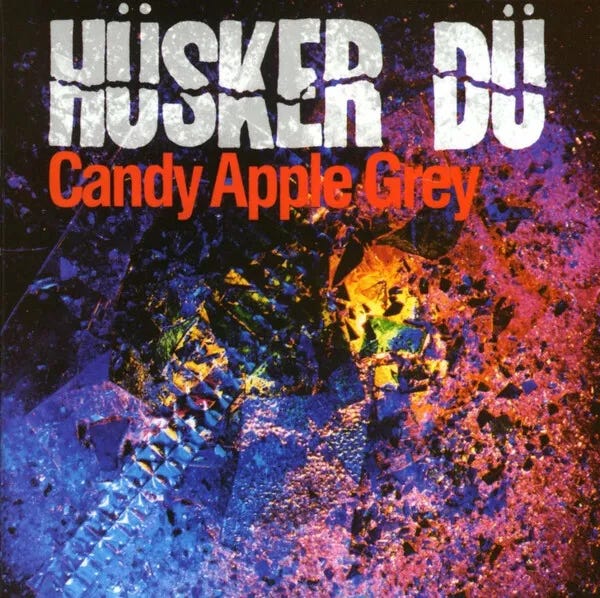
One month after the release of Flip Your Wig, the band was already in the studio working on Candy Apple Grey, their major label debut. The money from Warner Bros. theoretically should have helped these guys sound bigger and badass-er but instead the production only ends up shackling them in much the same manner it did for Sonic Youth on Goo. Zero in on Grant Hart’s drumming to see what I mean — it sounds strangely digital and makes me yearn to hear what Steve Albini would have done for this band at this time. They really set off to prove themselves as singer/songwriters, maybe after they watched Replacements mine that territory and get a major label deal and record out before they did, and they hand in three ballads instead of the emotionally-informed punk songs that they excelled at. Of these, Bob Mould’s “Too Far Down” fares the best, although the introduction—more of “Baby Song”’s annoying kazoo—should have been completely cut; his voice breaking to deliver “When I sit and think / I wish that I just could die” or the unexpected sobering of his voice for “I wish for real” are glimpses of the genius singer but in a different manner than the vocal intensity we were used to. The other two ballads survive on production than they do actual song. Mould’s “Hardly Getting Over It” immediately follows “Too Far Down” with six more minutes of balladry, and while the acoustic guitar sounds gorgeous—“Crystal” is all too an appropriate opening song title—it’s far too repetitive; Grant Hart submits “No Promise Have I Made” on piano, which is really brought out by its oceanic waves-type textures and climax. “Crystal” is not about the album’s sound, but rather methamphetamines—and it might be the best song ever about it—with Mould’s screaming as visceral a depiction of the drug as the electric viola for the Velvet Underground’s “Heroin.” “Don’t Want to Know If I’m Lonely” is the best of Dü’s late-period power pop tracks. Unfortunately, “Sorry Somehow” achieves its catchiness through the cheapest means possible, “You’re making me…”—big pause—“SORRY! SORRY SOMEHOW!” that these guys would never have stooped to just one year ago, and “Dead Set on Destruction” feels generic even by late-70s’ standards, let alone 86’s, even if 86’s standards for rock music were an all-time low.
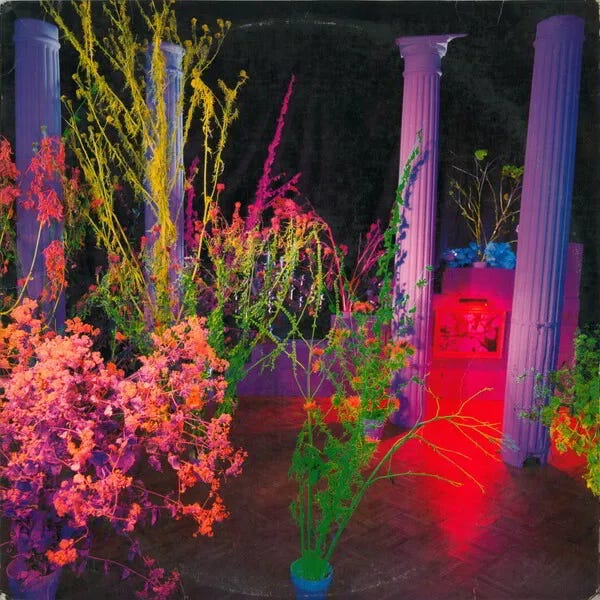
In an interview with No Age’s Dean Spunt that I can no longer find onlnie, Bob Mould said that had their final album Warehouse: Songs and Stories “been been pared back to a single record it might have had more impact, but we were already loggerheads at that point.” As the album title suggests, there’s a ‘content dump’ feeling to this album as it presents brutally unvaried power pop song one after the other for 70 minutes. It is not as diverse as Dü ’s Zen Arcade, nor the Cure’s Kiss Me Kiss Me Kiss Me or Prince’s Sign ‘o’ the Times both from the same year, to say nothing of Zen Arcade. Or frankly even Candy Apple Grey. I don’t even agree with Mould that there’s enough good material for a single album. The problem isn’t merely the production which softens their guitar and drums—death to a band like this one—but the songwriting is questionable too, full of clumsy lyrics (the 2-minute song contains riveting rhymes such as soul-hole and heart-apart) and similar chord progressions (compare the intros of “It’s Not Peculiar” with “You Can Live At Home”).
I adore “Charity, Chastity, Prudence, and Hope” because the celeste texture—while deployed mindlessly—is new for them, and the celeste is such a beautiful sound that the song becomes in intense realization of what they were after in the band’s late stage: proof that hardcore could be sweet. Moments like the rain sound effect in “Standing in the Rain” or the sleighbells that briefly show up on “Back From Somewhere” can only described as cute but lame; compare those to the insect buzz at the start of “Tell You Why Tomorrow” becoming an electric guitar. Closer “You Can Live at Home” is the only song here that is reminiscent of their old anger, as good and cathartic a swan song as we could have possibly had hoped for in these circumstances. Ultimately, this is a rare case of an album whose cover—the best vaporwave album cover ever—is better than the music.
Belated live album The Living End arrived in 1994. That every record—including live debut Land Speed Record and even the Metal Circus EP—is represented here, though it naturally leans heavy on Warehouse material since it was recorded in late-1987, but that there’s even more material from New Day Rising tells that they knew it was the better record too. The album doesn’t satisfy. To quote Mark Prindle, who did some of the best, honest writing on Dü available on the internet, “These were concerts to ATTEND, not to listen to at home.” There are three songs here that don’t appear on any studio recording: “Everytime” (great bass-line in the intro that gets lost in the mix); “Now That You Know Me” (Warehouse c-side) and “Ain’t No Water in the Well,” which is the only one worth looking for because the country vocals stand out. They cover Ramones’ “Sheena is a Punk Rocker” at the end, and it should have been more of a joy to hear a second-wave punk band cover the first-ever first-wave punk band.
A note here that if you only listen to their albums, then you actually miss out on one of their best songs, their cover of the Byrds’ “Eight Miles High,” released as a single between their two masterpieces. I cannot think of another case where one of the Greatest American Bands released a classic and then another one of the Greatest American Bands covered it and released an entirely different classic. Dü’s cover opens with a louder, fuzzier line faithful to the original, but whereas the original version launched into space, and in the paranoid, Reagan-led America of the 1980s, Hüsker Dü can’t imagine that far.
In an interview with The Quietus about Sugar, Bob Mould’s second band after going solo, Mould characterized Hüsker Dü “like a very, very fast jet plane that never really touched down and it didn’t have a lot of grounding to it and that was the beauty of that sound.” He was specifically describing Dü’s sound but I think the analogy is perfect for what happened to their career. The jet plane never landed. Dü didn’t burn out like other bands. They combusted. David Savoy, who the band brought in to help with managerial duties, committed suicide by jumping off the Lake Street bridge during the tour to promote Warehouse. Grant Hart felt that the band was to blame, as Savoy was caught trying to appease the growing tensions between Mould and Hart. The band scheduled time to work on a third album for Warner Bros. in 1988, but they never made it that far. Grant Hart, dealing with a misdiagnosis of HIV that he kept a secret, had become addicted to heroin. His heroin substitute had accidentally leaked mid-tour, afraid that Hart couldn’t keep it together to perform, Mould cancelled the rest of the dates and quit the band. Hart and Mould both went solo, while Norton went into the food industry, and wouldn’t get back into music until much later.
A quick couple of ‘graphs about Sugar. After two solo albums for Virgin, the label dropped Bob Mould. He toured extensively in the aftermath while shopping for labels that would bite and eventually found his way to Creation Records, the label that was notable for Shoegaze at that time. Mould formed Sugar with bassist David Barbe and drummer Malcolm Travis, named because there was a packet of sugar on the table when they agreed to play a spontaneous show together. Their three records together are probably what Hüsker Dü would have sounded like if they kept going: louder guitars and vocals, befitting the post-Nevermind world. Travis isn’t Hart—to be fair, no one in the world is—and rather than the insane drum volleys of Dü, Travis focused more on packing punch to push the songs forward. But without Hart to occasionally provide contrast to Mould’s vocals coupled with the fact that the songs seem to average 4-5 minutes equated to wearying albums that I never listen to even if there are good songs in them.
NME crowned Copper Blue album of the year—I wonder if they had to apologize for this one as much as SPIN did for calling Bandwagonesque the best album of ‘91—and is the better of their two albums thanks purely to some beautiful guitar work from Mould, particularly on “Hoover Dam,” while “A Good Idea” is the best Pixies song not released by the Pixies. “The Slim” is the best song here, and it reminds me of Lou Reed’s “Halloween Parade” as both songs are about dealing with the loss of close friends from AIDS—The Slim is what AIDS used to be known as before it was given a name—and there’s a lot of power in Mould’s voice (“When you left with your death / I felt empty when I look back”).
The band recorded a ton of tracks for Copper Blue, six of which felt darker and were split off into the Beaster EP. Opener “Come Around” feels like Creation’s influence rubbing off on Sugar, it’s the best shoegaze song by a non-shoegaze band I know, and frankly all the nu-shoegaze coming out of late all sounds like it’s imitating this song and not My Bloody Valentine. “Tilted” is just as good thanks to the heavy instrumental passages that’s more post-hardcore than most anything else Mould released as Sugar. Alas, most of the songs in the EP are puzzlingly long. File Under: Easy Listening is not the only sophomore slump whose album title tries to make a joke but ends up being all too real; the other is Grandaddy’s The Sophtware Slump. David Barbe writes and sings “Company Book,” but neither his voice nor the song are at all interesting. Mould gets in a really beautiful sunny guitar riff on “Your Favorite Thing,” but altogether the band’s sound and songwriting had reached a limitation that would never have stopped Hüsker Dü, who hurdled past any such issues when they were active off the back of insanely fast, tight and telepathic musicianship.
What impresses me about Zen Arcade is that it’s an album that’s grown more on me with every passing year, despite me no longer feeling emotionally broke enough to get as invested in songs like “Never Talking to You Again.” The power of good music! But I think a lot of it has to do with the horror that was in Hüsker Dü’s early music up through Zen Arcade, not just in songs like “Diane” or “Pink Turns Into Blue,” but just in how much Mould’s voice alone could communicate in a song like “Newest Industry.” Underground rock music in the 1980s used to be scary as it reflected society, from industrial (Throbbing Gristle) to punk (X) to hardcore (Dead Kennedys), to early Sonic Youth to even early R.E.M. whose music could be politically scary. But alas, horror, like comedy before it, just evaporated out of rock music when the underground became the overground. Even when new, good underground bands started forming decades later to keep the tradition of indie alive, it was never scary again despite the prominence of real world terror.
Hüsker Dü:
Land Speed Record [Live] - B
Everything Falls Apart - B
Metal Circus [EP] - A
Zen Arcade - A
New Day Rising - A
Flip Your Wig - A-
Candy Apple Grey - B+
Warehouse: Songs and Stories - B
The Living End [Live] - B

Sugar:
Copper Blue - B+
Beaster [EP] - B+
File Under: Easy Listening - B
Really great write-up!
Also… the Bob Mould / Dave Grohl concert is surprisingly epic? Especially ‘Hardly Getting Over It’
https://youtu.be/CMV15dL2MSo