
MF DOOM (Pt. 1)
All caps when you spell the man name

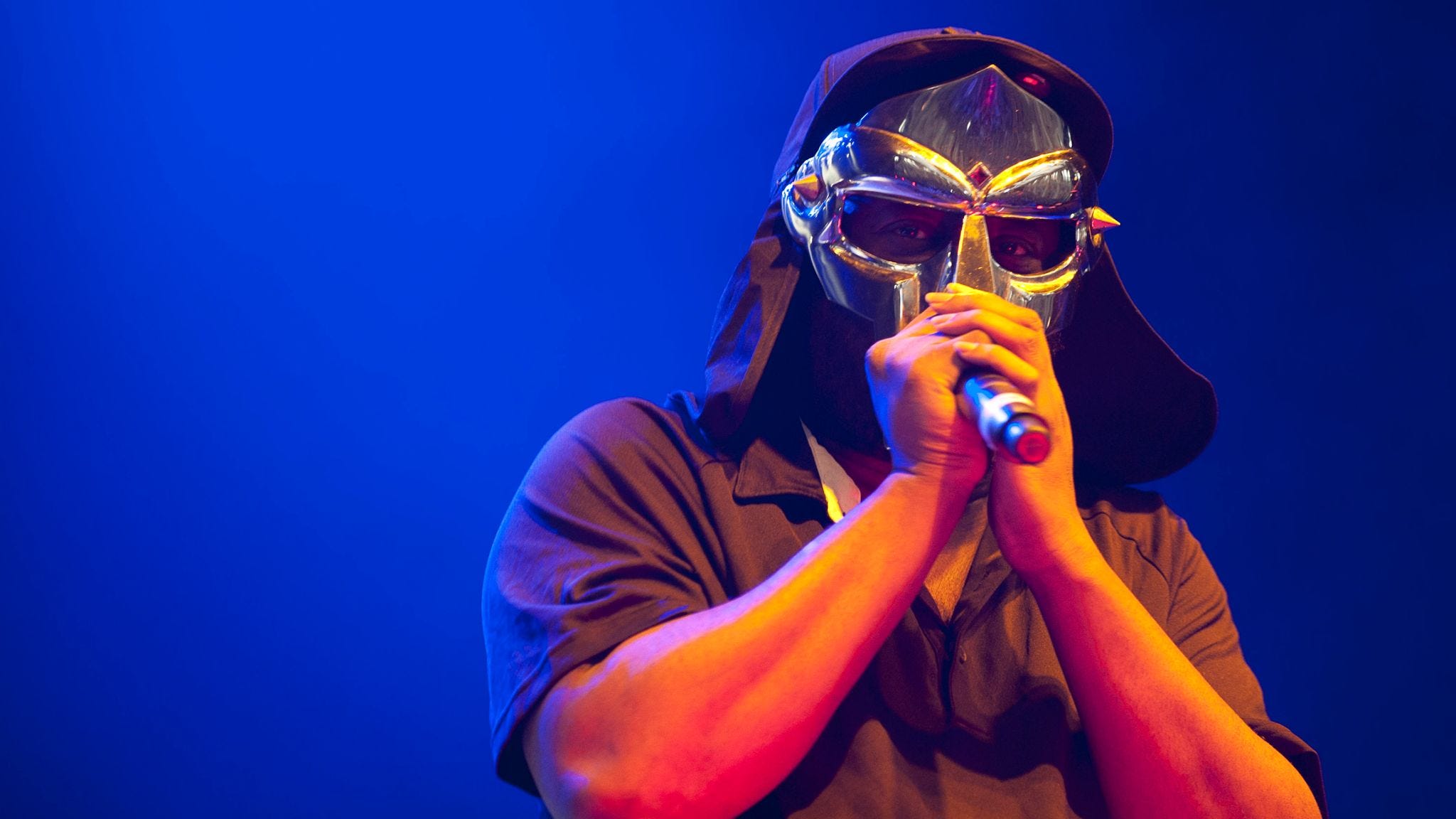
Dumile Daniel Thompson’s proved that a rapper’s persona is not necessarily the same one as the person doing the rapping. How can they be, when he rapped under three main aliases? In a genre obsessed with authenticity, it was a major shock for someone to divorce the persona and the personal, and MF DOOM did so by erecting as many possible personas as he could as if he were the rap version of Aphex Twin. True that by the time Thompson dropped his first rap nom de guerre Zev Love X and became MF DOOM and soft-launched King Gidora at the same time, Wu-Tang Clan’s RZA was also operating as Bobby Digital for example, but everyone knew RZA and Bobby Digital were one and the same person. By contrast, no one committed to the various number personas as DOOM did. The Aphex Twin comparison—which puzzlingly, I never see brought up even though it’s such low hanging fruit—makes sense: Aphex Twin used his other aliases to test out sounds he didn’t feel fit under his main name while making it hard for his fans to follow him. Similarly, MF DOOM’s Viktor Vaughn is a notably much more vulgar rapper than he is, made very evident when he “features” Viktor Vaughn on his own records.
Dumile’s first album as MF DOOM arrived in the fall of 1999. It was an important year for hip-hop. Less than a week before Operation: Doomsday dropped, Dr. Dre released the “Still D.R.E.” single ahead of his long-awaited follow-up to The Chronic and usurped the west coast crown that was up for grabs after 2Pac’s passing, and his protégé Eminem’s The Slim Shady LP was an instant commercial success earlier that year. On the other side of the coast, Jay-Z usurped the east coast crown after Notorious B.I.G.’s death in 1997, and brokered partnerships with both the west and south on his album that year. The Neptunes and Timbaland were making their mark on the charts with a fresh production style that would define the early 2000s. In the context of all of this money and bling, of an underground that had not fully formed yet—Def Jux was founded that same year but had not yet started releasing music—MF DOOM represented an alternate path for rappers.
Because he was born in London while his mother was visiting family, despite having lived in New York his entire life, he never became an American citizen: his family never completed the paperwork needed for his permanent resident status. As a result, upon completion of a European tour after the release of Born Like This, he was denied re-entry into the United States, and remained in the UK for the rest of his life. Never one for the spotlight, he said that he enjoyed the new anonymity even if he missed his family. That said, maybe I’m reading into it too much, but I attribute his displacement to be part of the reason why his output in the 2010s grinded to a halt: he stopped releasing solo records and only worked on collaborations until he passed away in 2020 from angioedema from a reaction to blood pressure medication. He was active for three full decades before his passing, and produced one of the most rewarding and fascinating discographies in all of hip-hop.
Zev Love X and KMD
He did not become MF DOOM overnight. For one thing, Gladiator had not yet been released, and MF DOOM would swap out his homemade metal mask for a replica from that film that’s so prominently featured on the Madvillainy cover. But Dumile had already been chewed up and spat out by the music industry. His first alias was Zev Love X, whose X was an homage to Malcolm X and whose name spelt EvolveZ backwards — which was super fitting because I can hardly think of any other rapper whose way of rapping has evolved as much as Dumile’s. As Zev Love X, his pitch is a young tenor, but it’s full of energy and his raps are tight, staying with the beat. By the time of Operation: Doomsday, he’s rapping off-beat. By the time of Madvillainy, his voice turned into a ground-shaking baritone, and in the 2010s, he adopts an old man flow here, a couch-sitting flow that may have had influence on Earl Sweatshirt adopting the same shortly afterwards.
Zev Love X and his younger brother Dingilizwe Dumile a.k.a. DJ Subroc formed KMD with Onyx the Birthstone Kid, and after Zev Love X’s appearance on 3rd Bass’ The Cactus Album, KMD signed a contract with Elektra Records for their debut 1991 debut Mr. Hood. The album has its uses as a historical artifact for DOOM archeologists, but any positive reviews come from its association to what X would go on to do, not what X is actually doing on the album. The De La Soul adoration starts off endearing and then quickly becomes annoying by the time “Humrush” rolls around; Prince Paul might have sampled Sesame Street but he would made it more musical than Bert humming around in an annoying frankly unlistenable drone. “Hard wit No Hoe”—not about what you think it is, but about farmers that are missing an garden tool, that turns out to be a metaphor for relationships—demonstrates an early attempt to play around with grander concepts. “Peachfuzz” nabs some colour to its beat with a vibes sample and was the lead single, and hit #11 on the Billboard Rap Singles chart, and whose success allowed Elektra to recoup its investment and sign KMD for a second album.
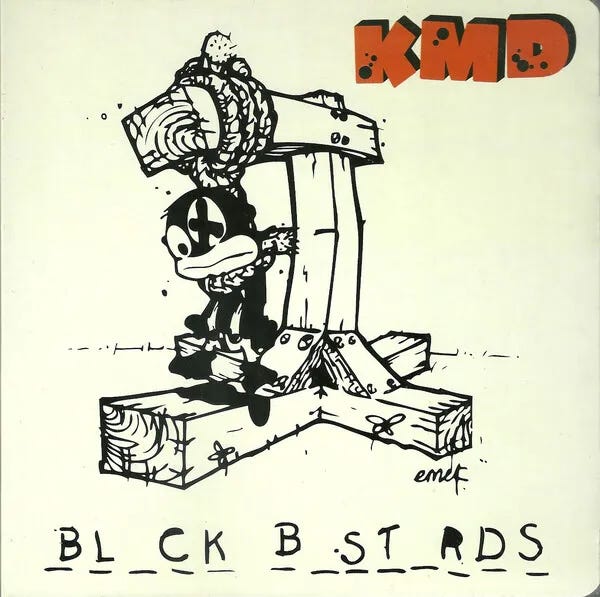
Onyx dropped out of the group, and more tragedy struck when Zev Love X’s little brother, Subroc was fatally struck by a vehicle in 1993. Legend goes that at the funeral, Zev Love X played songs intended for their second album for his brother, as if a vow that the music his brother worked on would soon come to be. It never did. Black Bastard was shelved by Elektra. The reason given to A&R Executive Dante Ross who signed KMD in the first place and who produced two tracks on Mr. Hood was that the cover, depicting a racist caricature being hung in a game of Hangman, was too offensive. The cover’s intent of killing stereotypes was easy to understand, but contextually, Elektra’s parent company Warner Bros. had already dealt with the blowback of Ice-T’s “Cop Killer” whose lyrics received criticism from cops themselves all the way to then-president George H. W. Bush, and rather than work it out with KMD for a different cover, Elektra washed their hands of them entirely. They wrote a cheque to MF DOOM and gave him the masters. According to Ross, DOOM was “unfazed” by the news. Regardless, Subroc’s death and his label turning his back on him would become part of DOOM’s supervillain origin. He retreated, couch-surfing among friends, and seemed to be done with music. Years later, he re-emerged, with black tights obscuring his face, performing at open mics and became MF DOOM, a play on his last name, “Doom-i-lay” that was already a nickname he had growing up, based on the Marvel character Doctor Doom.
Black Bastard would not see the light of day until after Dumile’s debut album as MF DOOM, released commercially by the short-lived label ReadyRock, in 2000. Though the album is better than Mr. Hood—more power in its concision, yes, but also more power in its beats and words—it’s the story that pushes it into “must listen” territory. Had it been released in 1994 as intended, then its lo-fi sound and De La Soul charm would have been out of place in a year when Illmatic and Ready to Die were released contrary to what some of its fans say. It sounds like 1992 to me, with the crispness of the boom bap drums that neither boom or bap that much—“Gimme”’s drums are feather-light and the potential of being the hardest track of the bunch is lost—and the jazziness of it all (the album opens with a Freddie Hubbard sample).
Again, it has its uses to backtrack to, not just because DOOM would use some of these samples later on—the “stupid” ending of “Plumskinnz (Loose Hoe, God & Cupid)” will show up King Geedorah’s Take Me to Your Leader—but also because songs tackle alcohol and weed here, vices that would both be associated with DOOM soon. On “Sweet Premium Wine,” the best song on the album, the brothers discuss alcoholism over a catchy chorus that tries to entice you to drink wine years two decades before Kendrick Lamar while on closer “Suspended Animation,” X raps about weed as a form of escape (“I’m fired up, I gots to get fried up”) over a sample of Cypress Hill’s “I Want to Get High.”
Whereas their debut album’s production credits was always credited to the entire group, Black Bastards is half produced entirely by Subroc or both brothers with the exception of “Contact Blitt,” which is handled by X solo. “Contact Blitt” is the most overtly jazz track on the album thanks to a Lee Morgan sample but X doesn’t let the sample breathe; the beat is too damn fussy. Subroc’s beats demonstrate a cratedigging love that may go beyond his brother’s: the Kain sample that opens “Get-U-Now”—that high-pitched pinging sound—is an insane pull, and deep bass-lines carry both that track and posse cut “Smokin’ That S*@%!” Alas, X’s hardcore raps, “My tool, my utensil / To draw lead in that ass like a pencil with a stencil” are far less interesting than his rapping under his new alias.
