
Mobb Deep
whole body laced up with bullet holes and such

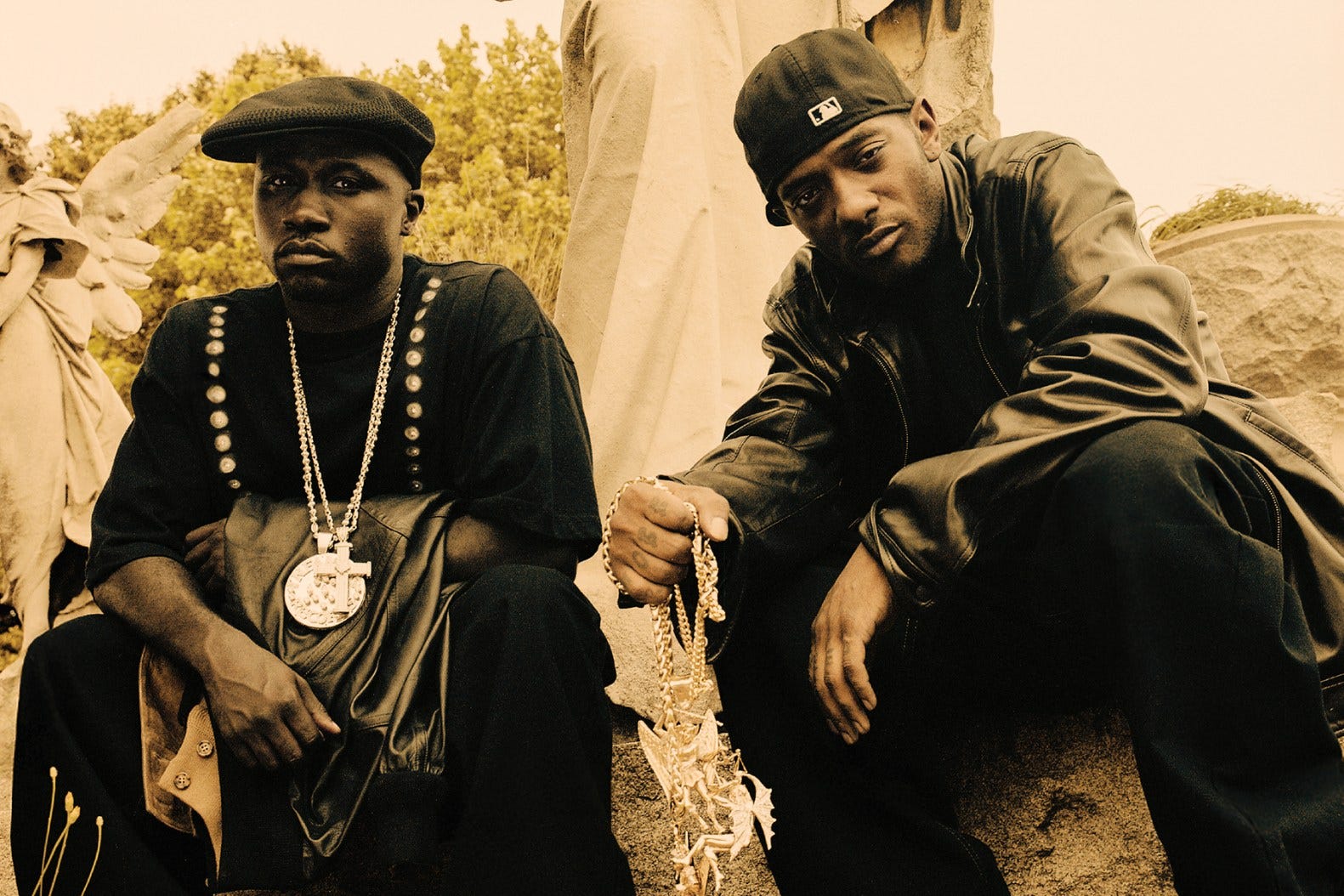
8 Mile’s musical gift to young, teenaged me wasn’t “Lose Yourself,” but played in the background at the start of the film and as the background beat for Eminem’s final rap battle against Papa Doc was a song that I’ve carried with me for a lot longer than the movie’s hit song: “Shook Ones Pt. II.”
I consider “Shook Ones Pt. II” to be one of the—oh, let’s cast the net wide to make it fair—fifty best rap songs of all time. Prodigy’s verse is an all-timer, rapping with considerable clarity, but the words and flow both feel off the cuff, which makes the threat of violence feel that much realer. “With bullet holes and such” is one of my favourite lines here for that very reason. Best of all is, “my gunshots’ll make you levitate,” just for that image! “I’m only 19 but my mind is older,” he continues afterwards, softening his voice just a touch compared to the preceding threat. It’s not (just) a brag, it’s a sigh, a glimpse of his reality.
Of course, it’s the beat that makes the song really special. There’s the instantly-memorable “SKREE” sound—like the “CHUH” of Smashing Pumpkins’ “1979” that same year, a strange and enticing sound that draws you into the song immediately—but producer Havoc crate-dug and further treated a sample choice to obscure its origins. The background instrumental could easily have been an electric guitar or keyboard, which is why no one could figure it out until he himself revealed in 2011 that the song’s sample came from Herbie Hancock’s “Jessica.” Here’s the thing: producers mining Herbie Hancock is nothing new as Digable Planets, LL Cool J and Geto Boys all did so before Havoc. But “Jessica” doesn’t come from Hancock’s fusion period, but rather, from his pre-fusion transitional period, specifically three seconds from the lone ballad off 1969’s Fat Albert Rotunda, and that extra bit of deep digging makes “Shook Ones, Pt. II” his best production.
The Infamous—the album that contains “Shook Ones, Pt. II”—plays like an accident and proof is that Mobb Deep never released another record nearly as good. In hip-hop’s hallowed history of discographies defined by a single album, Mobb Deep are only behind Snoop Dogg and Raekwon, and tied with Goodie Mob. Neither Prodigy nor Havoc are flashy on the microphone, which they used to their advantage by sounding menacing and leaning into Havoc’s atmosphere on their best songs. But they never grew up, and they exposed their own sound as an aesthetic dead-end: how many threats can you levy on faceless, nameless enemies before they all sound empty? Then, as the money started rolling into the genre, Havoc was impossibly tasked to replicate his steel-cold atmosphere within club-appropriate beats as hip-hop moved from the gangsta rap that they helped define in the first place to the shiny suit era and beyond.
Prodigy, real name Albert Johnson, came from a very impressive musical lineage. His grandfather Budd Johnson was a saxophonist who played with Louis Armstrong, Earl Hines, Coleman Hawkins, and Dizzy Gillespie, his father was a member of the doo-wop group the Chanters, and his mother Fatima Johnson (a.k.a. Frances Collins) was a member of the Crystals. He met Havoc—the son of a DJ and thus had access to lots of records growing up—when they were students at the High School of Art and Design, a background that would “haunt” them as audiences of the genre were too much focused on authenticity (and then a switch flipped overnight and then suddenly no one cared at all anymore) as listeners were quick to point out their art school backgrounds, “This guy’s a gangsta? His real name’s Kejuan Waliek Muchita.”
When the duo first started out under the name Poetical Prophets, they hung outside record label headquarters asking artists to listen to their demo tape, and Q-Tip was the only one who said yes, and proceeded to bring the two into the office and introduce them into the industry. At the suggestion of Puff Daddy, they changed their awkward name—Poetical, not Poetic—to Mobb Deep, and released the aptly-titled Juvenile Hell in 1993 whose title is all too apt: it sounds juvenile as hell.
Both rappers are still in their teens at this point, and their ages show in their tenor voices, which works to their advantage on “Peer Pressure” where they rap about exactly that and even concludes with a rare attempt at storytelling from Prodigy. That song’s beat is handled by none other than DJ Premier, and while Preemo’s beat does have his fingerprints in that loungey airport sound, it feels like a leftover that wasn’t good enough for Guru. I think the Large Professor beat is actually much better, to the point that I wasn’t shocked when he revealed he did the original beat and Premier handled the remix, but label 4th and B’way felt that Premier’s was better so they delegated Large Professor’s to remix status. Either way, the label putting both into the album was perhaps a tell that they felt the rest of the material wasn’t good enough. Which it isn’t. Without Preemo or Professor behind the boards, Kerwin “Sleek” Young or Paul Shabazz supplying hard-bumping bass but otherwise bog-standard boom bap with very minimal touches of jazz that honestly sounds like ‘89 more than ‘93. (Both were loosely associated with Bomb Squad, and co-produced Public Enemy’s “Tie Goes to the Runner.”) Famously, Premier and Large Professor moved onto bigger things, a young protégé also from Queensbridge Houses, while Mobb Deep were dropped by their label and threatened to be forgotten forever.
