
Vince Staples
Cry Babies

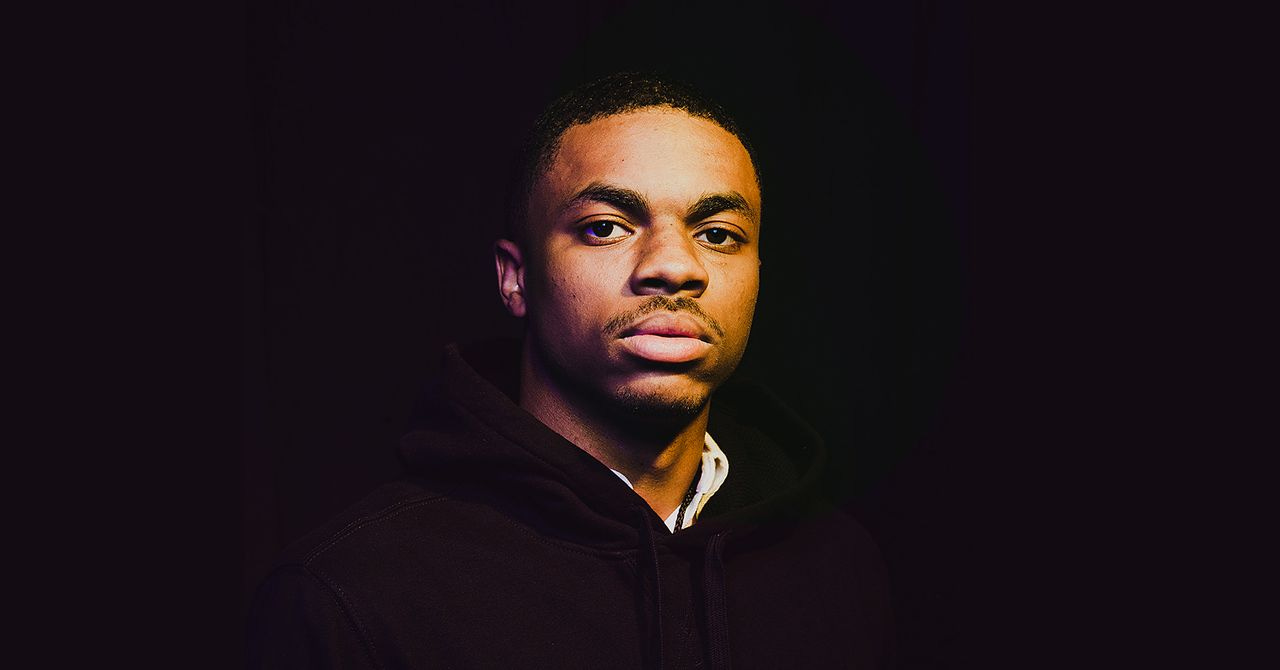
Vince Staples’ not-so-secret weapon is his voice. Not his flow, or his lyrics, but a voice that enunciates each word clearly, a voice that could turn a memorable line within a verse into a hook with ease—Coca-Cola owes him millions for “Bitch you thirsty, please grab a Sprite” as far as I’m concerned—and a voice that sounds eternally youthful yet at the same time worn down by a lifetime of hardship. (By contrast, his friend and once upon a time constant collaborator Earl Sweatshirt never sounded young.) I think of the Mobb Deep line, “I’m only young but my mind is old” whenever I listen to Vince Staples’ music because of how perpetually young he sounds.
He’s lived his raps. “I feel like a lot of my work has been an anthology of my neighborhood and my past,” he once said. His lyrics are best when they tap into autobiographical details, “I was twelve years old when they tried to sit me / On the curb, I got choke-slammed / For resisting arrest from a grown man / I ain’t even tell my mama what happened,” is a highlight verse from his most recent album.
Growing up, his father was sent to prison, leaving his mother to raise the family alone. As a teenager, he was caught with a stolen phone and was used to make an example of by authorities, who threatened him with multiple felonies which were ultimately dropped the charges if he changed schools. He ultimately dropped out of school, bouncing around and couch surfing where he eventually met Sydney Loren Bennett, a.k.a. Syd, who introduced him to Odd Future that ended up being his entry point into music and stardom when the prodigious and young Earl Sweatshirt brought Vince Staples onto his debut mixtape.
To be a Vince Staples fan is to be perpetually disappointed simply because Vince Staples seems so disinterested in music. His verses are often miniscule; his songs are short because of it, and the standard of his albums tend to be 10-12 tracks in 25-30 minutes. The one exception to this rule is a double album, which ended up just being 60 minutes that he literally made two discs’ worth.
Jayson Buford recently wrote a well-circulated substack post about Vince Staples, saying “He seems to be scared of his own electricity, scared of what it means to be a daring rapper, what it means to rap so well and rap so aggressively that people are shook of you.” Buford was one of the very few dissenting voices on Vince Staples’ newest album Cry Baby, received by everyone as a “political rap rock” album whose idea of rock turned out to be a mix of Gorillaz and Black Keys (i.e. safe-ass music for the masses) and whose idea of politics ended up only pointing out how gun violence, war, and television are bad. Staples is simply too bought out now, too comfortable, or maybe just not savvy enough to actually pull off either a rock album or a political album, so he plays it as safe as he’s been doing it for the last ten years. I teamed up with Eli Schoop for his Constantly Hating substack where we tore apart the album, a writer who I respect immensely because he’s honest and not afraid to call things out for what they are. It’s a breath of fresh air at a time when most critics seem to handle everything with a diplomatic niceness that only contributes to an audience who keep asking “What’s the point of criticism.”
For the record, I have liked Vince Staples ever since he broke through. He was a legitimate contender for west coast’s second-greatest rapper circa 2014-2016. This was a time when Earl Sweatshirt was in the process of detaching himself entirely from the prodigious and violent rap he was once known for; a time when Ab-Soul wrote himself out of the conversation; a time where Jay Rock revealed that his earth-shattering baritone worked best in small doses, features instead of full albums. There was literally no one else in the running. But rather than claim that title, Staples instead switched genres and dove head-first into EDM and then never bothered with that sound again, retreating into a forever-long series of albums that played it safe. His move to Def Jam after Big Fish Theory should have been historic, and instead he released an album with a trollish attitude that he and the label produced no singles for. A decade later, the storytelling of Summertime ‘06 or the wild sound of Big Fish Theory are now blips in the rearview. At the height of his popularity, he freed himself to do whatever he wanted, which turned out to be a Netflix TV star and likeable talking head.
His first two mixtapes are juvenile, and not worth backtracking to. Shyne Goldchain is bogged down near the end by weed carriers as Vince Staples sits out for three tracks in a row, and frankly dumb sounding beats. Winter in Prague’s production is handled entirely Michael Uzowuru, and the beats are slightly better as they match Staples’ coldness, but they’re strangely mixed, often louder than Staples, who sounds uncomfortable and exposed. (Uzowuru basically got his start with Staples on these two mixtapes, and then went on to produce Frank Ocean’s masterful “Nights”; what a leap in five years!) Staples makes his attitude very clear on “Winter in Prague,” rapping “Music mean nothing to me if I ain’t eating right” from the jump, which is why I believe Buford’s analysis about him: he fell into rap, and considered quitting music altogether after these two failed to leave a dent.
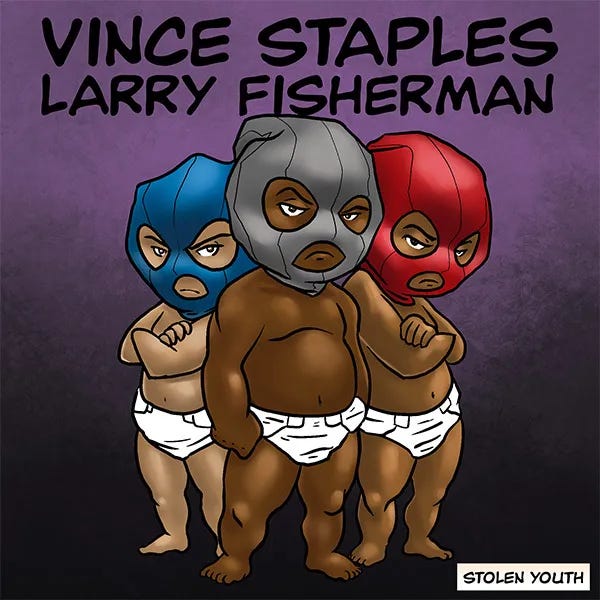
Thankfully, Staples befriended Mac Miller and the two released Stolen Youth. Staples has said that Miller helped refined his skills as a rapper, “Like, he would sit there and teach me how to make sure I’m on beat, and like rap with certain energy. It took a long time... I was other everyday with nothing else to do for, like, months, and he was teaching me how to rap on beat, how to project. I didn’t know how to ad-lib, I didn’t know what ad-libs was!” It’s a great match because both were shedding off expectations that were thrust upon them: Staples was known best for his association with Earl Sweatshirt; Mac Miller didn’t want to just be known as a frat rapper and was taking steps to be taken seriously as, not just a rapper, but also as a producer. Both start to take shape as the artists that we would know them as on this mixtape. Released two mere days after Miller’s Watching Movies With the Sound Off—effectively Miller’s coming out as a serious artist—you get some of the same features (Ab-Soul and ScHoolboy Q) to sweeten the deal, broadening Vince Staples’ phonebook. Miller casts the net wide for these beats under his pseudonym Larry Fisherman in a way that makes it feel like he was trying to figure out what style fit Staples best, so you get the haunted playground vibe of “Fantoms,” the soft cloud rap of “Killin Y’all” and the clunky organ-led boom bap of “Sleep.” “Stuck in My Ways” is my favourite track here, but that might just be because of a clever Portishead flip.
It’s either Stolen Youth or Shyne Goldchain II that are his best mixtape. The majority of the songs are produced by No I.D. (even if they’re likely cast-offs from Common), the most professional sounding beats he’s rapped over thus far. But Staples’ lyrics start moving away from the scattershot lyricism of his earlier work for straight-up autobiography. “Nate” differentiates him from any other gangsta rapper from his coast at this time as he dedicates a song to his father who, “Used to think he was unbreakable (because) he did fed time,” and ultimately leads to the visceral punch, “As a kid all I wanted was to kill a man / Cause my daddy did it.” Elsewhere, “Oh You Scared” is his first of many great tracks in his discography. “Most of the time that I’ve been living, we been public housing tenants” is how the first verse starts, “Never had no pot to piss so bitch, excuse me if I brag a lot,” immediately tying the song back to “Humble” earlier where he boasted, “Homie, I ain’t humble, I deserve this shit.” The second verse gets into detail about his mother’s turn to religion after his father went to prison and his own, personal feelings about the subject, “Father up in prison, Jesus here, but he ain’t struggle wit us / The church only made shit worse / The money we was given ain’t go to God / Mostly nice cars that reverends could sit in.” Jhene Aiko sweetens the deal without tipping the scales into R&B territory, pointing ahead to Staples’ similar partnership with Kilo Kush on Summertime ‘06.
