Underworld
something violent for me and you

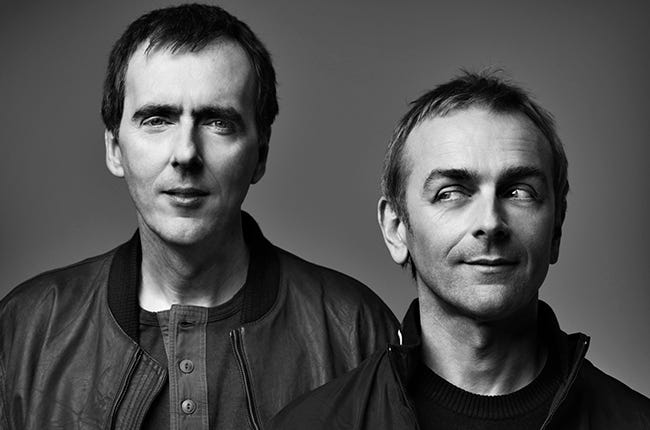
Underworld were among many in the 90s that navigated the rock to electronic pipeline. Primal Scream began as a C86 band, named after a NME compilation of British jangle pop bands, before discovering acid house and partying with DJ Andrew Weatherall who would give the band their first hit and multi-platinum album while Daft Punk Guy-Manuel de Homem-Christo and Thomas Bangalter first started as a punk band. Even the Orb’s Alex Paterson got his musical start as a roadie for Killing Joke, whose bassist was his childhood friend and flat-mate, and who was the one who introduced Paterson to Orb co-founder Jimmy Cauty.
Likewise, Underworld’s core members, Karl Hyde and Rick Smith, began first as a new wave band called Freur in the 1980s whose single “Doot Doot” was a minor hit in New Zealand and reached #57 on the UK charts, earning them a nomination for Best Band and Most Promising Act for 1984 in Smash Hits. They were not long for this world. After two albums, synth player John Warwick left the band, and the remaining four—Smith, Hyde, Bryn Burrows, and Alfie Thomas—formed Underworld with bassist Baz Allen immediately afterwards.
This iteration, later referred to by Hyde and Smith as “Underworld Mk1,” put out two albums at the tail-end of the 1980s. Both Underneath the Radar and Change the Weather are treated merely as curiosities by the band for fans to eventually backtrack to. Not that either are particularly bad, just vending machine synth-pop with some occasionally catchy choruses marred by 80s’ pop production where every single element is competing for its life, and any funk potential is rendered inert by the stifling sound. The guitar of “Sole Survivor”—whose wordy choruses are fun—is absolutely garish and makes me look forward to a time when Hyde would bring his guitar on stage and make a point to never play it, as are any instances where the band slow it down and ask you to pray for a better world (“Pray”) or pray for refugees (“Beach”). Bad lyrics too: “There’s no pity for the man who’s on his knees in hell / For William Shakespeare - heh!” Just left scratching my head at that “joke” there.
Underworld Mk1 came to a crashing halt after a stadium tour opening for Eurythmics in North America where the 5-piece disbanded. Karl Hyde stayed in New York as a guitarist for Debbie Harry while Rick Smith went back to Essex. Prompted by the Stone Roses’ “Fool’s Gold” on MTV, Hyde moved back the UK, linking back with Smith, where they met DJ Darren Emerson, who would join Underworld for “Mk2” and usher them away from their new wave origins and head-first into Britain’s burgeoning rave scene.
Born in the late-50s, both Karl Hyde and Rick Smith were well into their 30s by the time they started releasing music as “Underworld Mk2” which is part of why their version of techno sounds little like their contemporaries. Similar to early Wire or early Police’s unique takes on punk rock because their members were older, Hyde and Smith were able to approach rave music with a different, shall we say ‘outsider’ sensibility. Were they younger, would they have bothered so often with ambient tracks modeled after Brian Eno’s Before and After Science or Fleetwood Mac’s “Albatross?” Maybe, but I have my doubts! That, and the fact that they were a band that played techno, not a DJ.
For one thing, no R&B vocal samples. Instead, Karl Hyde played the rock front-man in a genre with no such thing, pressing stream of consciousness-style poetry—often from overheard public conversations and which he subsequently rearranged into strange mantras—into melodic ideas that makes their music feel like wandering big cities at night. His voice was less focal point and more a texture, fading into the pulsing beat from Smith and Emerson. Moreover, he brought his guitar with him, but only to add density, but its sheer presence was another signifier that rock listeners could vibe with.
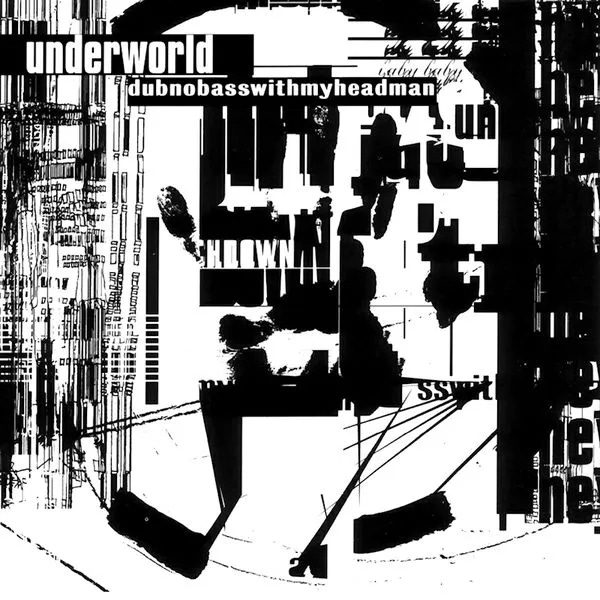
I s’pose there’s a “baby’s first techno” record feel with their first album as Mk2, Dubnobasswithmyheadman given the post-rock expanse and the whole notion of a front-man who also plays guitar, but what a starting point it is! The album is seductive in its mysterious lyrics, the songs’ expansive architectures, and overall urban nighttime atmosphere. Influences are used as mere reference points such that the music feels fresh, even some 30 years later. Hyde cites David Bowie’s Low in the way Bowie “threw his ego away” and Lou Reed’s New York with its end-to-end immersion in a city through fractured storytelling as key to Dubnobasswithmyheadman, and obviously it sounds like neither. Meanwhile, the spacey effects of “Surfboy” is reminiscent of the Orb, the digital vocals of “Tongue” to Kraftwerk’s Autobahn over swirling guitars that sound like Slowdive’s Pygmalion which this album pre-dates, and the easy-going melodicism of “Dirty Epic” to New Order.
We’re dropped into the rave on the first song, and from there, we follow Hyde, Smith, and Emerson out of the club, a passenger to their mission to head deeper into the city where phrases are charged with a meaning that eludes you. “Mmm… Skyscraper I Love You” is stitched together by fragmented phrases that arrive like questions (“Mmm… Skyscraper, I love you,” said over and over as if Hyde’s declaring it aloud to each passing building), revelations (“And I see Elvis!”), and observations (“I see porn dogs sniffing the wind for something new”), each one a hook, and here’s how I know: I’m hooked with every new phrase into this strange world that Hyde has built out from various notebooks and magazines during his time in New York City that he later cut into a montage. Each of those percussive rolls feel like a beast waking up, which is sometimes what metropolitan club districts feel like at night. Later on, “Dirty Epic” builds to a climax into “Cowgirl,” whose title, I must say, points to an interest in sex that seemed to completely evaporate in their discography after 1999. The album then cools down with “River of Bass,” which is exactly what the title suggests and what should have closed the album instead of “M.E.”, an awkward slice of synthy pop music that feels tacked on and all-too reminiscent of a Mk1 that wasn’t yet far enough in the rearview.
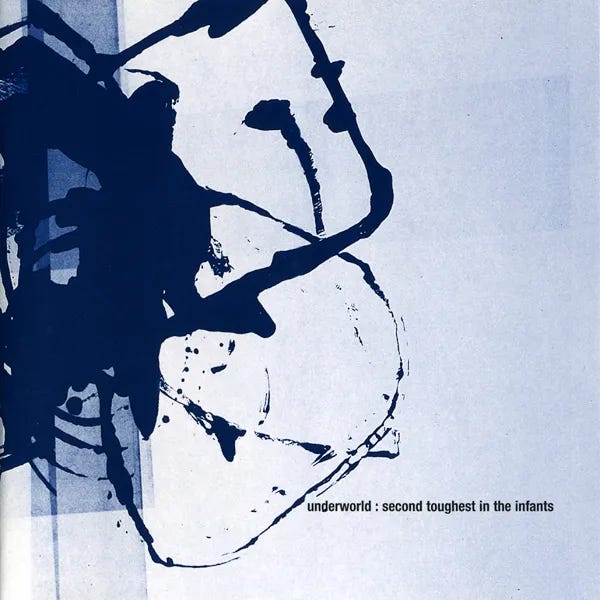
I love the sequencing of Second Toughest in the Infants, kicking things off with a 16-minute behemoth and following it up with another track of almost the same length which, in total, runs just shy of half the album. It feels like a prog album. It’s bad-ass because Underworld does this and asks their fans to trust them, but in doing so, they also weed out the non-fans, a filter at the very start such that the ones that are left on the dancefloors are the ones that were there to fucking dance. Any complaints about the lengths or repetitive natures of these two songs just doesn’t make sense because they are constantly shifting through their multiple sections — the clue is in the titles. Some (rock) listeners want techno to be more ambitious, less repetitive, more like rock music, and here Underworld give them not one but two techno songs that are exactly like that and it’s still not enough for some people?
“Juanita - Kiteless - To Dream of Love” is one of their many epics that feels like witnessing a DJ set in the slow introduction of new elements (i.e. the faded blue keyboards around the 3:40 mark) or stripping away of old ones (i.e. taking away the drums so the ending feels like an exercise of American minimalism before bringing them back in). Meanwhile, “Banstyle” is muted and gentle, and yet also bright in its back and forth chords, which they shade with an additional synthesizer. “Sappys Curry,” on the other hand, starts off with what sounds like slide guitar, which is then looped until it forms the back-bone of the second half. There’s an immersion here within these two songs that you simply don’t get on the following Underworld albums.
Once you’ve made it past, the band gives you the crowd-pleasers, be they sexual and spacious (“Confusion the Waitress”) or rhythmic (“Rowla”). “Blueski” is a beautiful instrumental with a guitar loop that feels like this techno band envisioning old blues for their own purposes, while also predicting Boards of Canada’s change in direction for The Campfire Headphase about a decade in advance. “Stagger” is the best of their ambient songs, with the repetition of each “straighten” feeling like Hyde is trying to vocally right this drunken ship, and the powerful vocals for the hook, “The naming of killer boy” over a climbing and anxious synth-line, are some of Hyde’s best-ever singing. The Pearl’s Girl EP can be found on expanded editions of Second Toughest and showcases how deeply fertile they were at this time; the instrumental “Mosaic” would a career highlight for literally anyone else, and the guitar line is equal parts pensive and mischievous.
Months later, the use of “Born Slippy .NUXX”—originally a b-side to “Born Slippy”—on the soundtrack of Trainspotting thrust them into an even greater spotlight when it hit #2 on the UK charts and would remain their highest-charting single. The song’s opening measures are intensely memorable, all breathy synths and clanging chords that slowly become a dizzying mix of vocals and drums that have this primal intensity in how breathless they are. I never hear the song out in the wild over here in Canada, but heard it at a bar in Banff the day after I got married — which was this weekend.
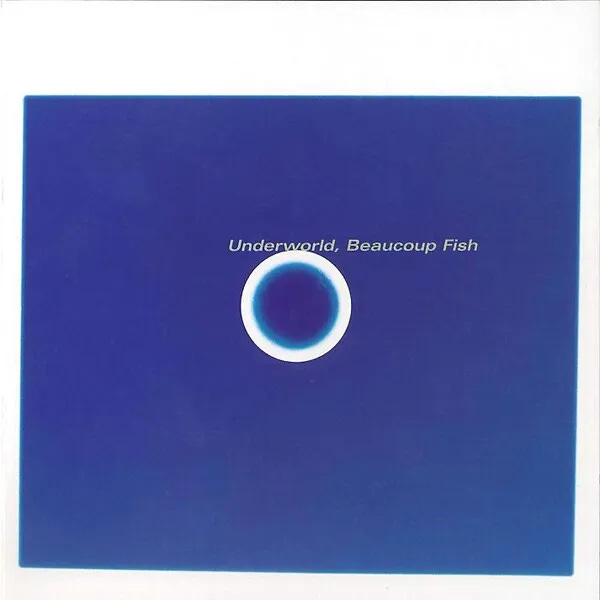
With all eyes on them, Beaucoup Fish would be their biggest album, which dispatches of Second Toughest of the Infant’s proggier, expansive tendencies immediately after “Cups.” The first time I heard “Cups,” I was shocked by Beaucoup Fish’s relatively muted reception—everyone tells you about those two mid-90s albums, but rarely anyone mentions Beaucoup Fish—and then “Push Upstairs” knocks the wind out of your sails. Not that “Push Upstairs” is a bad song by any means! I love the claustrophobic piano fighting to get out of the dense mix, but there’s something about it that screams “this want so badly to be a rock song” that takes me out of the immersion that “Cups” worked so hard to build (a key moment in “Cups” is the aqueous synth around 7 minutes in, where it imitates a blues player briefly). Elsewhere, “Bruce Lee” fails for the same reason, trying to imitate the flashy success of big beat with a clunky beat that was dated to the late-90s the moment it was recorded. “Skym” wants desperately to evoke something given the anxious keyboard line that appears halfway through, but I always leave the song with no images or emotions to mind, especially compared to the previous album’s “Stagger.” “Kittens” and “Moaner” are both relentless bangers that I tire of halfway through. The best song is “Jumbo,” whose repetition of “click” can feel, depending on the context of the lyrics, sexual (i.e. the click of a camera), sad (i.e. the click of a phone disconnecting) and altogether presciently digital.
The best songs from Beaucoup Fish (i.e. the first four) make up the bulk of live album Everything, Everything that functions, with its super-charged readings, as a best of compilation and a waving good-bye, to the last millennium and to Darren Emerson, who left the band for fatherhood.
Most people stop listening to the band here. Don’t be one of these people.
In a must-read interview with Spin for the release of Barbara Barbara, we face a shining future, Karl Hyde waves away the albums that came between:
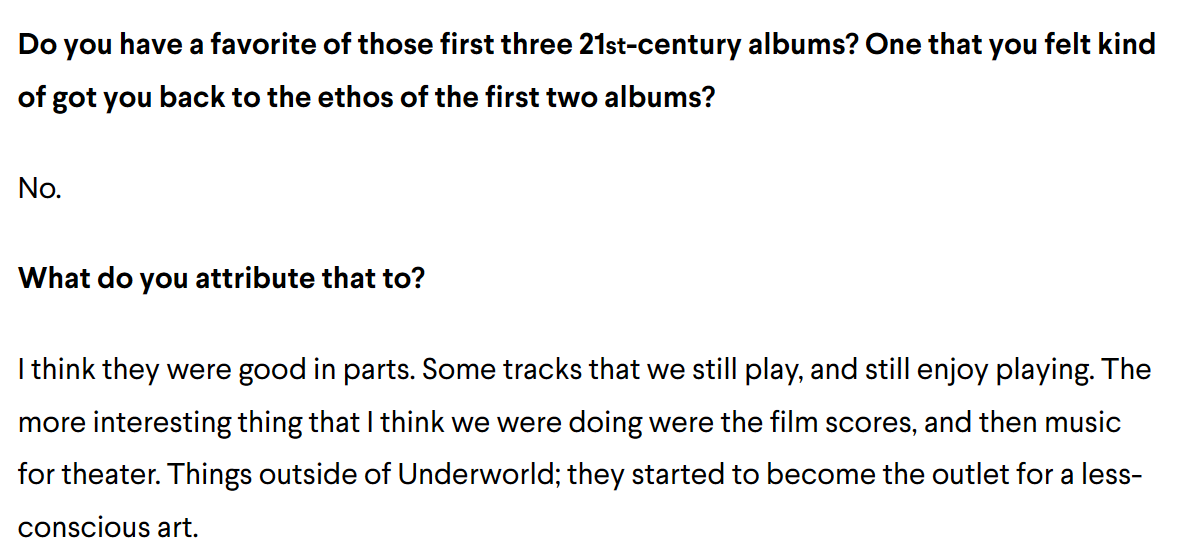
Shame, that. I’ll state here, highlighted for effect, that “Two Months Off” from A Hundred Days Off must surely be their best song post-96, which hits a sustained, ecstatic bliss in much the same manner as did “Born Slippy .NUXX” that makes “Two Months Off” feel like a genuine successor. The mix of the album is less dense and the vibes more chilled out, which you might attribute to the departure of Emerson or Karl Hyde’s newfound sobriety, but I just think it makes sense logistically besides that. Hyde was 45 years old while making the album, and I’m a decade away from that, and even I’m not attracted to the idea of throbbing and grinding at a rave or club. Would-be ragers like “Mo Move,” “Twist” and “Luetin” are convincing because they have a little breeze to ‘em, as are three ambient tracks which are treated more like interludes.
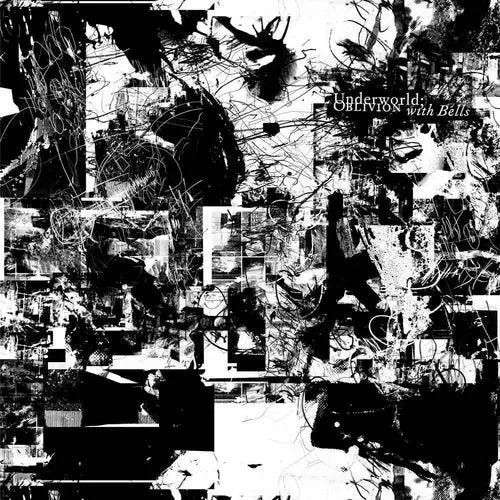
Though the cover seems like a deliberate call-back to Dubnobasswithmyheadman, Oblivion With Bells is messy when it’s not in chill-out mode, which I attribute squarely to Karl Hyde. Hyde seemed bored of his own observer-type approach to vocals and lyrics around this time, and so he semi-raps his way through “Ring Road” in a way that gives me PTSD flashbacks to early Massive Attack, and attempts profundity on “Boy, Boy, Boy” that’s squarely out of reach for a limited vocalist like him. He’s mixed too loudly on both of these songs, and the band wanted to use a live drummer for the latter but settled on what amounts to a machine anyway in U2’s Larry Mullen Jr. Hyde doesn’t have a natural gift of melody-making when it comes to singing, but it worked on Underworld Mk2’s first few albums because he used it as a reserved texture, and his well of cut-up lyrics started to run dry early on which is in stark comparison to someone like Mark E. Smith that seemed like a waterfall of never-ending unique turn-of phrases. That said, you still can’t write the album off because Hyde and Smith continue to make impressive soundscapes. The industrial percussion in the climax of “Beautiful Burnout”; the Four Tet-like water rippling effect of the keyboards on “Glam Bucket”; the cheeky turntablism of the first half of “Best Mamgu Ever.” Both of these albums have songs worthy of the Underworld name, and yet Hyde thinks that the Sunshine soundtrack—by turns atmospheric, blaring, and corny, just like the film that “““““heroically””””” slammed together Alien and A Nightmare on Elm Street—is “more interesting,” go figure.
The only time they bottom out is on Barking, an album full of pop choruses and bright melodies meant to be played in the afternoon slots of festivals to bored, sexy people. “Diamond Jigsaw” might be their worst song. When the arena rock guitar comes in with that basic-ass riff but mixed so wimpily—because they know they’re better than this, deep down, somewhere—my mind zones out completely. The “Heaven” refrain of “Always Loved a Film” is equally bad: it sounds like shit. I wish they essayed drum and bass 10 years ago on Beaucoup Fish where they might’ve knocked it out of the park instead of what we got on “Scribble.” By the time closer “Louisiana” rolls around, it’s too little too late, a passable Radiohead ballad—it should be noted somewhere here that Radiohead watched Underworld live before Kid A, and Underworld had a part to play with Radiohead mostly ditching guitars—that looks ahead to Karl Hyde’s solo career, more on that later.
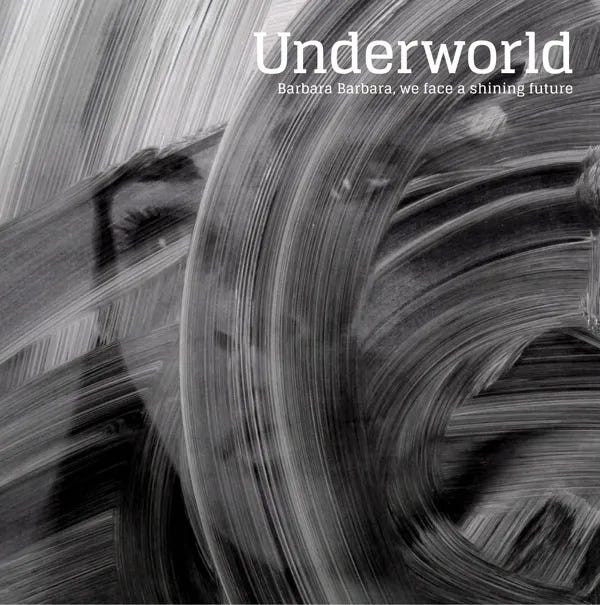
Barbara Barbara, we face a shining future was received as a comeback album, but I don’t see it, partly because I’m out here championing A Hundred Days Off and half of Oblivion. Yeah, it’s better than Barking, but so is basically everything in existence. Opener “I Exhale” is their most convincing quasi-rocker with the urgent glammy stomp of the drums, and I appreciate that the album’s obligatory ambient detour is a flamenco guitar track, but the last three songs are a pleasant comedown that the album hasn’t earned and it becomes clear that the album’s all too content to ride this zone of comfort. Strawberry Hotel arrived eight years later, which starts with a volley of heavy-hitting beats in the first half and then completely loses the plot, featuring a 5-minute spoken word lament for Emperor Nero’s wife, a 2-minute a capella version of an earlier song on the album that no one asked for, and then a shameless 9-minute rip-off of Kraftwerk’s “Europe Endless” in “Gene Pool.” It’s their second-worst album after Barking.
Underworld were an albums band which makes sense since Hyde and Smith grew up on albums, and came from an album culture, and sequenced their own albums to play in a logical, narrative way. Contrary to other “true” techno acts, EPs are not important to their legacy. The fan-favourite Riverrun project is three EPs made up of fragmented experiments that are ultimately underdeveloped but hard to really notice as the band don’t separate out the tracks — each of the EPs were all dumped unceremoniously as one single track titled “audio.mp3.” Lovely Broken Thing was the first and worst of them with potentially good songs like “JAL to Tokyo” and “Lenny Penne” playing their hands as very early, clear filler with “Dub Shepherd,” and the harsh noise of “Peggy Sussed” makes me think of Low’s late-period albums when they dove into the same textures, but not as good. Pizza for Eggs is both more sonically diverse, and at the same time, narratively cohesive, which starts with guitar-assisted ambient, then moves into dub, and Hyde’s best Tricky imitation. I’m a Big Sister, And I’m a Girl, And I’m a Princess, And This Is My Horse is the last and best of them, leaning hard into one direction and committing into ambient more than they ever have across an entire release. Drums barely appear, and when they do, they’re hardly the focal point; the beat of “Peach Tree” doesn’t appear until well over 5 minutes in where it finally joins the synth swirl, and both the drums of “Peach Tree” and “Mowed Path” both leave well before the rest of the song is up.
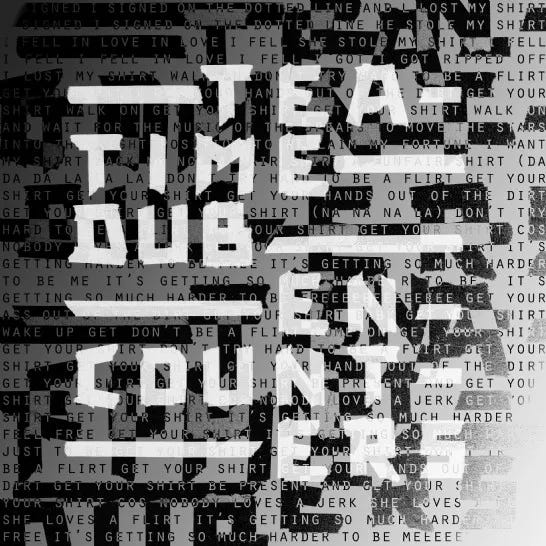
In 2017, after the release of T2 Trainspotting, Underworld cornered Iggy Pop by setting up a studio and tracks ready for him at the hotel. It’s logical: Iggy Pop and Underworld were among the highlights of the original soundtrack; they bookended the soundtrack to the sequel, and Iggy Pop had been gracing his rugged voice to other electronic producers around this time. The 4-song EP Teatime Dub Encounters sucks because Iggy Pop exudes ‘old man yells at cloud’ energy the entire time. Opener “Bells & Circles” reminisces on “Because nobody wants you to be able to do / The things that make you feel good / Like you can’t smoke on the airplane / I remember smoking on the airplane” which, hilariously, becomes the focal point of the 7-minute song as he harps on it in every subsequent verse. “I’ll See Big,” with its gentle pads and druggy backing vocals singing “Hold on…” makes fun of nerds in 2018; newsflash, Pop, nerds won the war; everyone’s playing D&D. Worst of all is “Get Your Shirt” where Pop tries to move his voice around for a rave track that just doesn’t come off.
Near the end of that year, Underworld embarked on another digital journey with the Drift series, releasing music on a weekly basis, which were subsequently compiled into EPs and then a compilation with extra tracks. Bored of the album release cycle, it’s what the Smashing Pumpkins had envisioned with Teargarden by Kaleidyscope but executed in a way that isn’t totally embarrassing for band and audience alike. As with the Riverrun EPs, not being beholden to a heavily-scrutinized album lets them experiment a little, hence collaborative jazz tracks with the Necks, including a nearly 50-minute jam on the second EP, and then working with members of the newly formed and not-yet famous—not yet even releasing music—Black Country, New Road whose vocalist/guitarist Tyler Hyde is Karl’s daughter.
But the results are mixed: for every track that’s worth keeping—“A Very Silent Way” (snaky bass-line from the Necks’ Lloyd Swanton); “Custard Speedtalk” (Eno-like piano doing a lot of heavy-lifting); “This Must Be Drum Street” (A Hundred Days Off with more pump); “Schiphol Test” (synthy strings)—there’s another that’s equally annoying. Hyde’s words often have a “I couldn’t be assed” quality to them, to the point that I can’t help but think that lightweight bop “Brussels” and distorted rager “Soniamode” would be better without him, to say nothing of spoken word catastrophe “Hundred Weight Hammer.” The fifth is the weakest by my estimation, as “Tree and Two Chairs” can’t decide if it wants to be a lively jam or ambient music, and ends up being middle-of-the-road, bobbing along for far too long, while “S T A R” sounds like it was thought of on-the-spot during a film festival as Hyde eyes different celebrities (who’s Betty Grable?).
In 2013, Karl Hyde embarked on a solo career and released Edgeland to coincide with the documentary The Outer Edges which followed the River Roding from North Essex to Thames. It’s an album full of the ambient pop tracks that had peppered the Underworld albums but with the air of Serious Musician TM, hence the sophisticated chamber-work of “Your Perfume Was the Best Thing” or the piano grounding the fussy rhythms of “The Boy With the Jigsaw Puzzle Fingers.” There’s a mild electronic influence that seeps in from time to time that I’m unconvinced by: the bubbling noise framing “Angel Café” feels underdeveloped; the insistent 4/4 beat on “Shoulda Been a Painter” serving as little more than a reminder that this man once made dance music. Helping Hyde was a new collaborator, guitarist and producer Leo Abrahams, who had been working with Brian Eno for a while, and my guess is that it was Abrahams who likely make the introductions between Hyde and Eno, who released two collaborative albums the following year.
I’m happy that these two musicians, with similarly warmly melodic voices and vested interest in ambient music, would get together and decidedly not make ambient music, considering it basically always takes someone else to coax Eno out of his ambient mode, particularly David Byrne and John Cale. (Actually, his best ambient music post-77 is also done with collaborators.)
Someday World is the lesser of the two albums Eno and Hyde collaborated on together. The horns sound oddly cheap on the first two songs given how good Eno is with making anything sound good, and Karl Hyde’s voice often strains and sounds weak pitted against the highly-precise production around him. I like the backing vocals that comes in to help out with the hook of “Man Wakes Up” but that “shiiiiine” is far too Gallagher bros for my taste, and I like the krautrocky midsection of “Witness” but it also feels like a reject from the glitch-poetry album Drums Between the Bells spliced in.
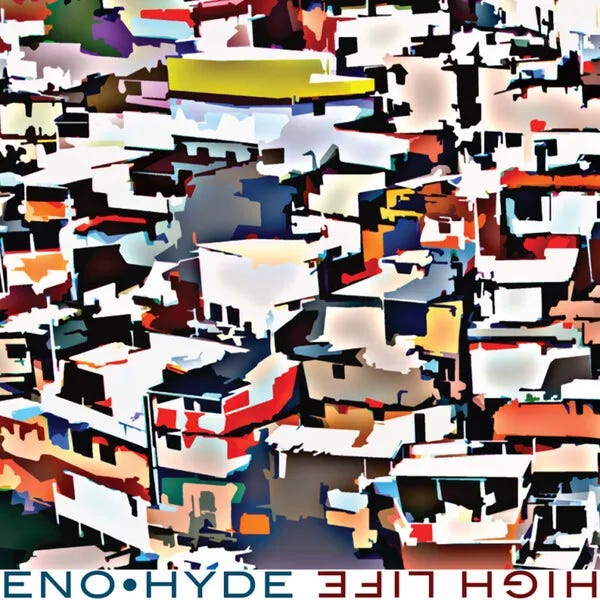
High Life, however, is the best thing Brian Eno has done since 1977 — not thinking of his production work here. The album plays like a modern take of Talking Heads’ Remain in Light that basically no one has ever bothered with ever since. Certainly not the Talking Heads who severed ties with Eno shortly afterwards and settled on being the best live act since the mantle was up for the taking after the Who; certainly not LCD Soundsystem, who sometimes gets brought up in comparison to Underworld but the way I see it, Underworld were an electronic band with rock influences whereas LCD Soundsystem were the exact opposite. Even the album feels constructed in a way similar to Remain in Light with the heaviest groovers coming first, moving to more of a mid-tempo, and then ending with a deserved comedown.
The African-inspired funk rhythms of the first four songs seem like an endless fount, and I seriously question why Warp released Someday World first when it sounds like b-sides by comparison. Is it the lack of “songs?” The lack of “singing?” Because both work to the album’s advantage: longer songs let Eno’s production methods shine as he piles in more and more instruments: instrumental “DBF” feels like Afro-glitch, the likes of which I’ve never heard before or ever again, culminating in a blistering organ from Eno that reminds me so much of what Hancock did for David on “Right Off” with its cleansing noise. “Lilac” ends with a raindrop keyboard effect from Fred again… that actually sounds like the colour that the song is evoking. Meanwhile, the compared lack of singing lets Hyde’s voice shine far more compared to how exposed he was on Someday World. Alas, any hope that Eno would continue making songs was quickly dashed when he returned to long-form ambient immediately afterwards, lovely cover of the Velvet Underground’s “I’m Set Free” notwithstanding.
With every passing day, I feel more strongly about two declarations, both hot takes, which is that (1) this is the best album of its year, although ranking not so far behind is Africa Express’ rendition of Terry Riley’s In C that Eno also sang on, while many other albums from 2014 that were acclaimed at that time feel deeply embarrassing to me now, and (2) this is the best album that Karl Hyde was ever involved in.
Albums:
Underneath the Radar - B-
Change the Weather - C+
Dubnobasswithmyheadman - A
Second Toughest of the Infants - A-
Beaucoup Fish - B+
Everything, Everything - B+
A Hundred Days Off - B+
Oblivion With Bells - B-
Barking - C
Barbara Barbara we face a shining future - B-
Strawberry Hotel - B-

EPs:
Pearl's Girl - B+
Lovely Broken Thing - B-
Pizza for Eggs - B+
I'm a Big Sister, And I'm a Girl, And I'm a Princess, And This Is My Horse - B+
Teatime Dub Encounters (with Iggy Pop) - C
Drift Episode 1 Dust - B
Drift Episode 2 Atom - B
Drift Episode 3 Heart - B
Drift Episode 4 Space - B
Drift Episode 5 Game - B-

Karl Hyde Solo:
Edgeland - B+
Someday World (with Brian Eno) - B
High Life (with Brian Eno) - A
This is excellent you did a great job on this. I could nitpick some of your opinions but that's what makes them opinions. To me 'Dubnobass' and 'Second Toughests' are works of total genius, although I agree the last song on 'Dubno...' is a little hokey. Agree that 'Barking' is the low point but I liked 'Strawberry Hotel.' I mostly just think it's great that they're still doing it after all these years producing works of uniform quality, and live they still deliver! Thanks for this post!
Great read, I'm probably spinning their early '00s albums again one of these days.
Much congrats on getting married! (I'll follow suit next March!)